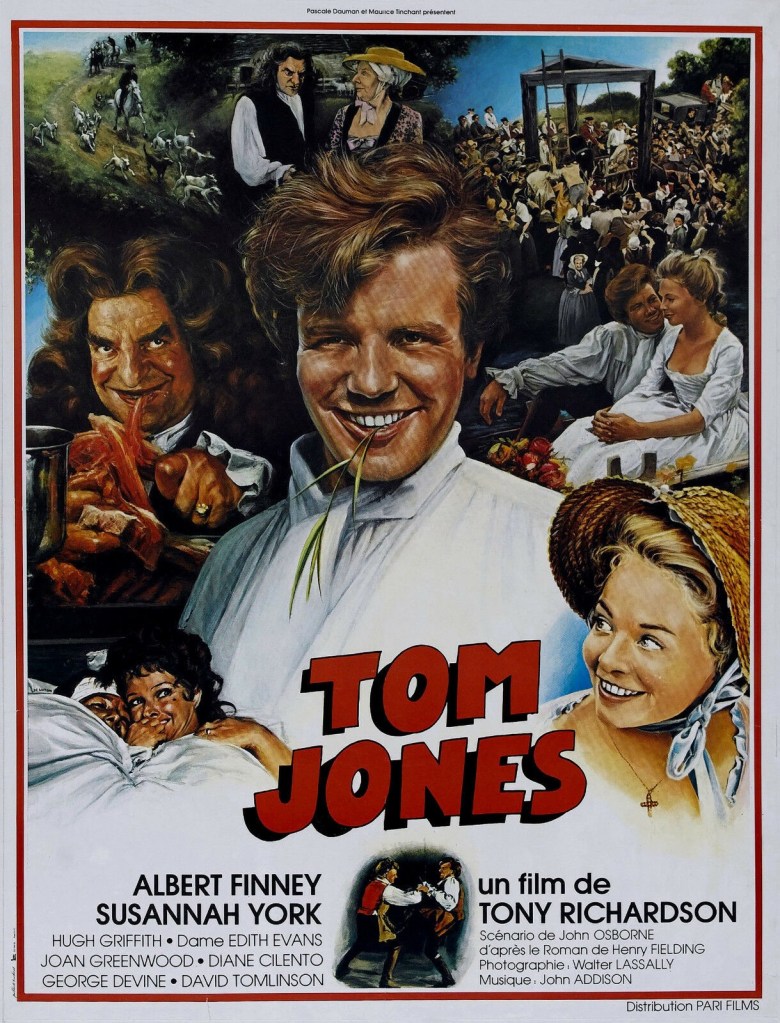
Until I was 13 we lived in a tiny village. Trips to the cinema were occasional, very exciting treats. These happened when we were away on holiday and also in our nearby small town, five miles away, in a very small independent cinema in a converted chapel. The man who ran it used to get the big films of the time – a year or two after they’d been shown in the big towns. We didn’t mind waiting! Occasionally, when a really good family film came to our town we’d get in the car as a family and go and see it. I remember us going to see Swiss Family Robinson and the cinema was absolutely packed with people standing and sitting on windowsills. It was the same when Tom Jones arrived.
When I was a teenager, and we’d moved to the town, I would go weekly to the cinema with my friends. We didn’t mind what we saw! The most popular, of course, were the ones we’d read all about in magazines like the Bond films, Georgy Girl, Alfie and Ben Hur.
Cinemas in those days had just one screen, although many town (not ours!) had more than one cinema. There was always an A film, the one you went to see, plus a B film which was shown first. In the intermission the ice cream vendors walked down the aisles with their trays of drinks, tubs and choc ices. There were adverts played in the intermission. In my small home town the ads were stills promoting local businesses, particularly the coach company the cinema proprietor and projectionist drove for in the daytime. People were allowed to smoke in cinemas, and a huge proportion of the population smoked.
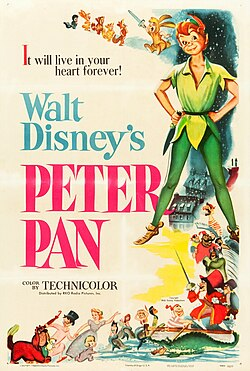
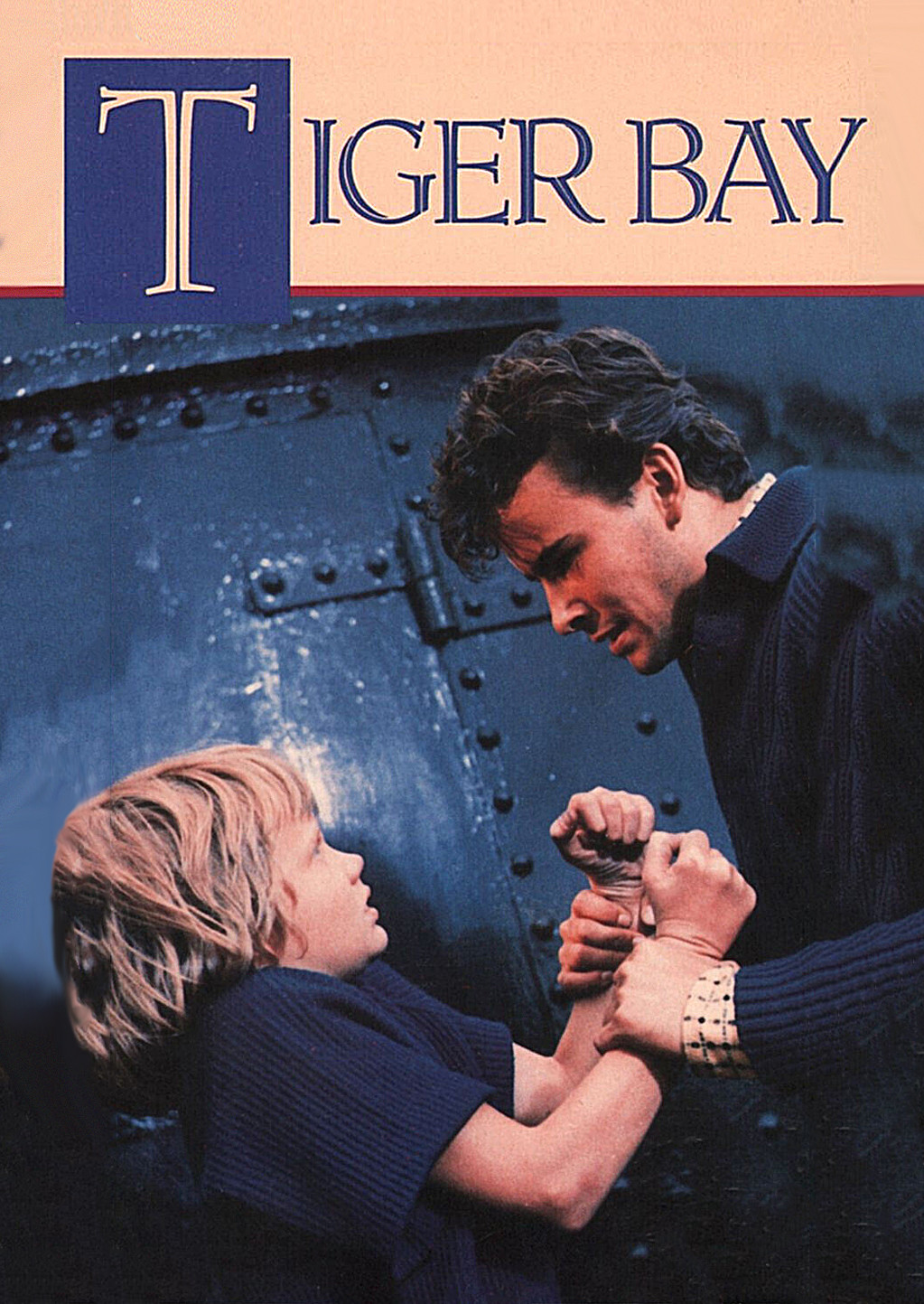
Apparently, I was taken to see this when I was about two years old. I don’t remember the occasion!My grandmother took me to see this in Cardiff when I was staying with her one summer. It’s set and filmed in Cardiff which is probably why she was keen to see it. I see now that it was a crime film so I was probably far too young to understand it.Our little cinema was crammed for the showing of this in around 1964, a year or so after release.
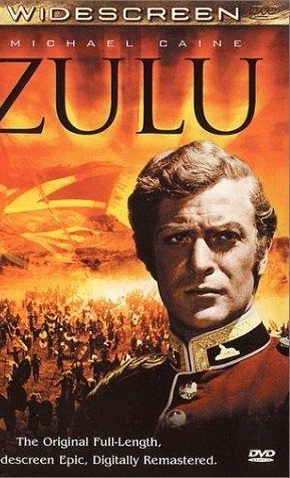
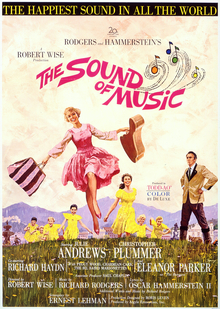
For both Zulu and The Sound of Music, we took a day trip to Cardiff to see them when they were still new.
TV
Once we had television, in the early 60s, we could watch old films at home. In black and white and on a very small screen!
Who could have imagined that by the 1980’s most of us would have VHS recorders and would be renting videos? Or that we would race on from there through DVDs to streaming? Even more so, it would have been impossible back then to imagine being able to watch films and TV on pocket-sized gadgets. These gadgets are known to us as phones but they bear no resemblance whatsoever to the early phone of the 1950s, either in appearance or capabilities.
Images courtesy of Google Images. Facts double-checked through Wikipedia. I make every effort to avoid infringing copyright. However, if anyone objects to any of the content in my posts get in touch directly with me and it will be removed.
Merry Christmas to all who read this blog. Thank you all for stopping by. Here are some thoughts on how things have changed since I was a child.
Paper Chains
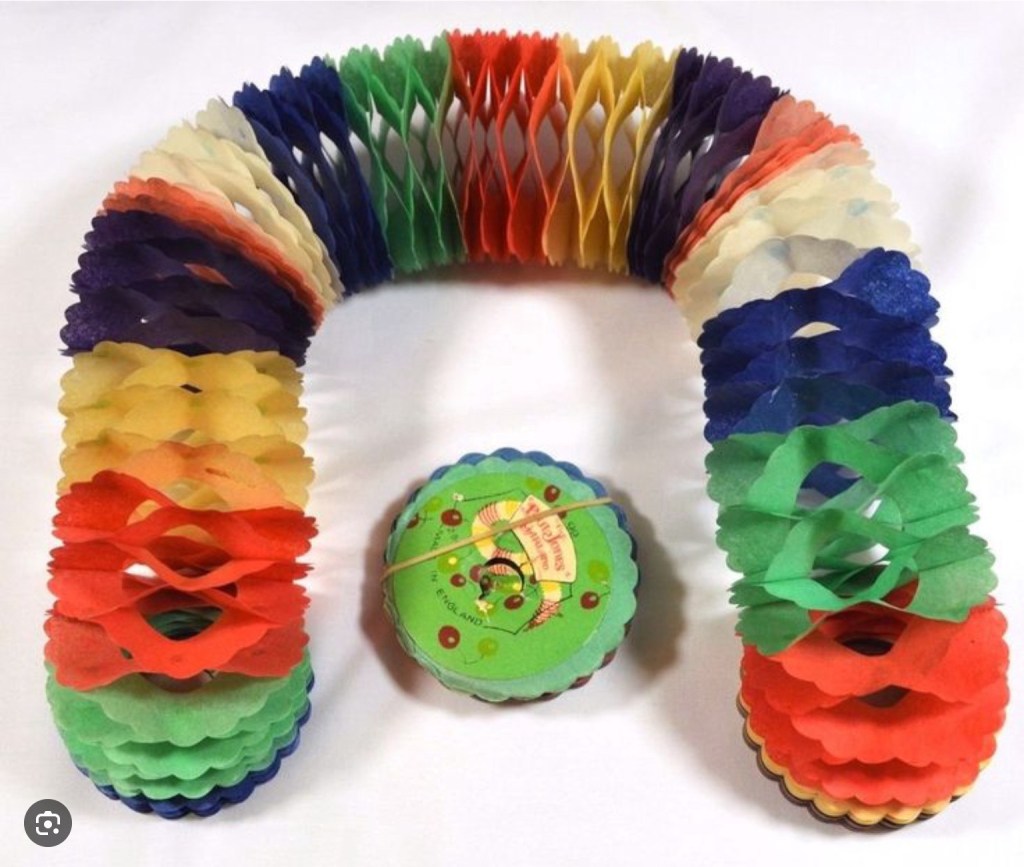
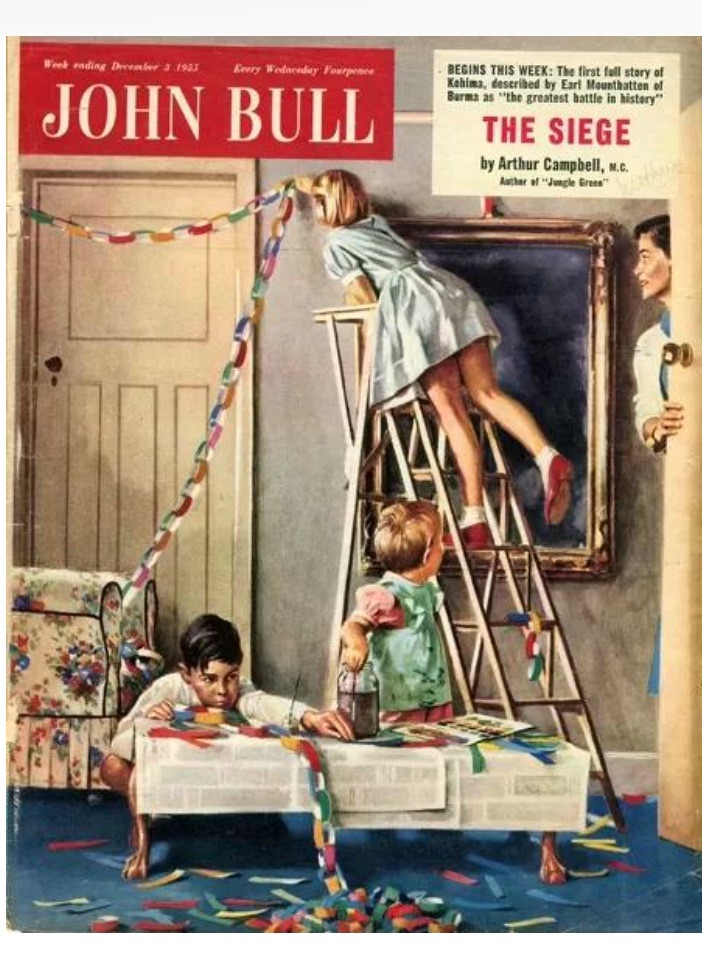
It seems to me that Christmas lights outside houses and in gardens get more popular every year. When I was a child the main focal point was the tree. How we loved helping to decorate it. I still have a few of the glass baubles from the 1950s which went on our tree every year. We also used to put holly and balloons up (not next to each other!). And then there were the paper chains which were pinned up in the ceiling and went from corner to corner. These paper chains would be carefully folded afterwards and saved for next year. You could also buy packs of coloured, gummed paper rectangles to make your own paper chains and we children loved doing that.
Christmas Day Post
There used to be a postal delivery on Christmas Day in Britain right up until 1960! It’s hard to imagine now. My grandfather was a rural postman with a round which covered a wide area of scattered farms and houses. Back in my dad’s childhood his father would be out all day on Christmas Day delivering cards. People used to send cards then to arrive on the day, like birthday cards. The family also went to chapel three times on Christmas Day so their Christmas dinner and present exchanging was always on Boxing Day.
Stockings
Children’s Christmas stockings were knitted ones. They now come in a huge variety of shapes, styles, sizes and materials. Ours were light brown woollen knee high stockings. A relative had knitted two pairs for my dad to wear under wellington boots when working outside. They were coarse and itchy so he never actually wore them and they were repurposed as Christmas stockings for his three children.
Circus on TV on Boxing Day
On Boxing Day there was always a circus on TV in the afternoon. We only had one channel when we first got a TV in 1961 so it was the circus or the circus! There wasn’t normally anything on TV in the daytime apart from the preschoolers’ Watch With Mother just after lunchtime. So watching television in the afternoon was a rare treat! TVs then gave out such a weak light that in order to see the picture in daylight you had to close the curtains.
Twelfth Night
The tree and decorations would be put up just before Christmas (not like now when they start appearing in November!) and it was considered extremely bad luck to take them down before the Twelfth Night, 6th January.
Father Christmas v Santa Claus
When I was little we never called him anything but Father Christmas. Now you rarely hear him referred to as that. I knew the name Santa Claus from Christmas songs on the radio but he was always Father Christmas then. I always preferred the pictures which showed him wearing a long hooded cloak. Other kids preferred the tunic, belt and knee boots image. It’s just down to personal preference.
Credit to Wikipedia and Google Images. If anyone objects to my use of a particular image please contact me and it will be removed.
I have had so many lovely comments responding to my Changes Since the 50s post. Thank you all! So I’ve decided to post another one. A simple list again, brief, no pictures. I hope it rings some bells.
Cars had no seat belts or reversing lights. They had three gears and you had to pull the choke out in order to start the engine – then remember to push it in again.
Most people smoked (80% of men and 40% of women in the early 1950s) and you could smoke anywhere. In cinemas, on trains and buses, in hospitals, cafes and restaurants.
Peaches, pineapples, salmon and cream came mostly in tins.
Nobody wore helmets when cycling.
Suitcases didn’t have wheels.
You answered the telephone with a greeting, your exchange and your number e.g. “Hello, Somewhereton 456”.
All children had ‘hobbies’.
Everyone wore vests, winter and summer.
The word vegetarian was rarely heard. Likewise vegan.
Most people did the football pools weekly.
You used encyclopaedias to look things up. A home set if you had one, in the library if not.
When I was a child, a new diary always appeared at Christmas. Sometimes I found one in my stocking, other years it might be a present from a friend or relative. It was so exciting starting a new diary!! I loved filling in the details inside the cover and I always enjoyed looking through all the ‘useful’ information in the front. Back then, we had diaries to record daily events as they happened rather than to note things happening in the future. My mum loved writing. She wrote stories (several were published), she really loved writing letters and she wrote a daily journal into old age. On January 1st, once we’d written our thank you letters and New Year’s resolutions, we were encouraged to start filling in our diaries. From time to time as the year progressed, Mum would remind us to write in our diaries. I still have a few of mine and most years my daily entries only lasted the first few months. However, some of my 1960s diaries are full for the whole twelve months.
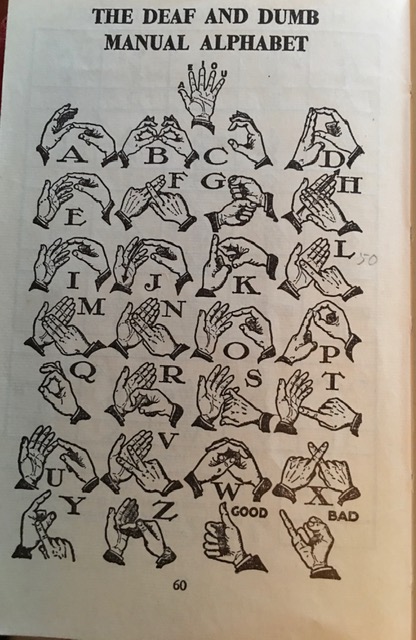
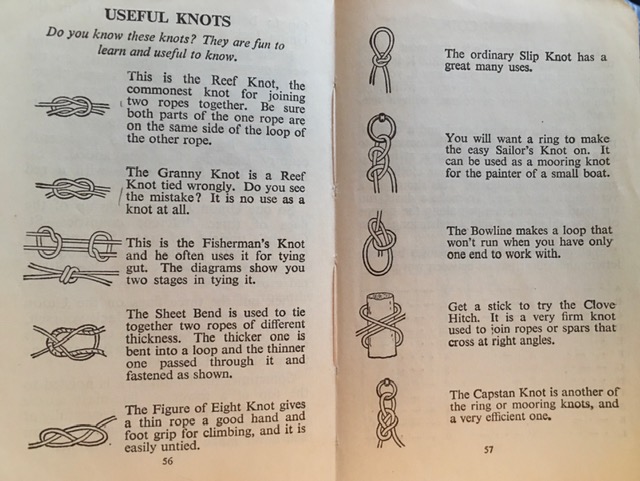
My 1959 diary was an Enid Blyton one. Even though it was pocket-sized and slim it had roughly 70 pages of ‘useful’ information before the dated pages started. Looking at it now, I see that I didn’t record much in it beyond March but I can clearly remember trying to learn Morse Code, Semaphore, the hand signing alphabet and knots from the pages shown. There were pages, too, on First Aid, history, wildlife, recipes and pocket-money making ideas.
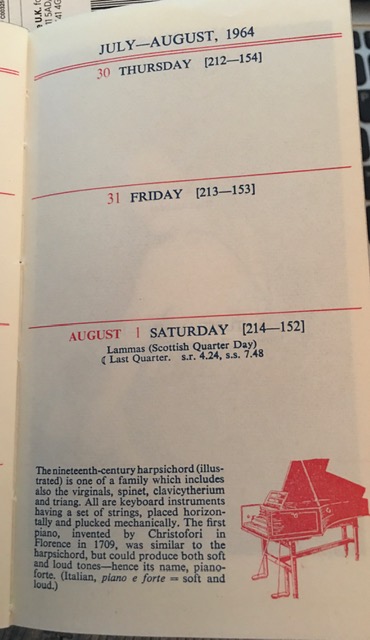
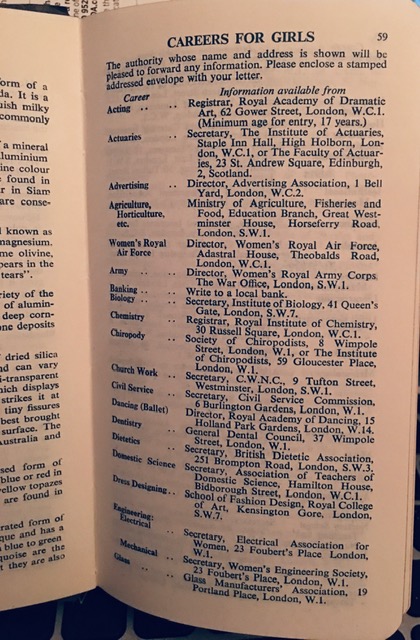
My 1964 diary was titled Lett’s Schoolgirl’s Diary. Also a slim, pocket sized one it still managed to pack in approximately 70 pages of information thought to be useful to schoolgirls. In it there are log tables, conversion charts, lists of French verbs, weights and measures charts, embroidery instructions, photographs of famous people and much more. At the end of each week’s double page there is a snippet of information with a drawing. A small selection of these pages is shown below.
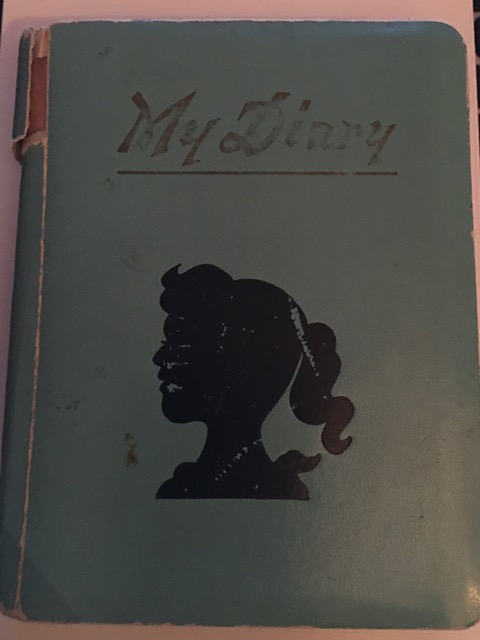
The diary below is from 1963. My sister had a matching one in red. We thought they had great covers! It’s one in which I wrote every day for the whole year, often in some detail. The interesting thing about this one is that the first two months and the first week of March are a detailed first-hand account of what’s now known as the Big Freeze. Because we lived in a remote part of mid Wales it affected us more than it did some other parts of the country. Most of the roads are narrow and twisting and became blocked when it snowed. As well as road problems we had burst pipe and boiler problems in both the village school and the secondary school I’d just started in which was five miles away. There were only three weeks out of those first nine when I was able to attend school for the full five days. I record the rain washing the last of the snow away on the 7th of March.
No credits this time as all the photographs are mine – hence the poor quality!
So, readers, I turned 70 last week. I hadn’t been one bit excited about it as I feel the pandemic prevented me from having a normal year when I was 69. As it turned out, two days before my birthday was officially the country’s second easing of lockdown no. 3. It was a great week to have a birthday as I was able to see some family members I hadn’t seen since before March 2020.
My birthday led me to think, as it often does, of the tales my mum used to tell me about the times when I, my brother and sister were born.
At the turn of the century, birth at home was the normal. Within 50 years, the majority of women had hospital births. Maternity hospitals or homes were usually independent from general hospitals. Men were never with their wives through labour and definitely weren’t present for the delivery.
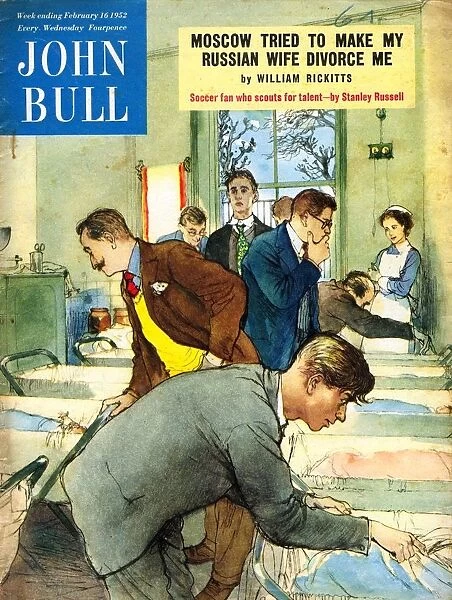
The front cover of a 1952 edition of John Bull magazine showing new fathers meeting their offspring for the first time in the nursery – blue cot blankets for the boys, pink for the girls.
Bottle feeding started to become popular in the late 40s and by the time I was born women were actively encourage to choose bottle over breast. Years later when my mum saw her grandchildren being breastfed she bitterly regretted not having been encouraged to do it.
Back in the 1950s women stayed in hospital for a period from eight days to two weeks after giving birth. My mum used to tell of being in the maternity hospital for two weeks after each of us. This was all very well when it was a first baby but when were other children to care for, and the father had to work, it was a problem. I was three and a half when my sister was born. My brother (two years old) and I were driven to our grandparents in a different town to stay for the two weeks my mum was in the hospital.
Once born, babies were looked after in the nursery and only handed to their mothers when it was time to be fed. If your baby was unsettled in between feeds you didn’t know about it. Feeding was strictly timed. The routine for newborns and for the first few months was a feed every four hours, at precisely 10.00 am, 2.00 pm, 6.00 pm, 10.00 pm, 2.00 am, 6.00 am. Night feeds were given by nursing staff in the nursery so that the new mum could get her sleep. I remember my mum telling of nursing staff walking down the central aisle of the maternity ward with a large trolley containing babies, handing them out and announcing “Feeding time, mummies!”
A 1950s nursery in a maternity hospital.
Before being discharged, the mothers were taught how to bath their new babies. The system then was to fill the baby bath, test the temperature with your elbow, soap the baby all over, then lower it into the water. The first time my mum did this with me after returning home, she soaped me all over then lowered me towards the water. I wriggled and I was so slippery from the soap that I slipped out of her hands and landed face down in the water. My mum thought she’d killed me and had to shout for my dad to come.
As well as being instructed to feed to a strict schedule, new mothers were told to put their babies outside in their prams in all weathers to benefit from the fresh air. They were also told that crying was good for their babies and exercised their lungs. When they were outside, the mums couldn’t hear them crying. They would bring them in to be fed and changed at the exact times dictated by the nurses at the hospital and by the district nurses who visited the home afterwards.
A 1950s coach built pram.
Credit to Google Images, Pinterest and Wikipedia. As always, I make every effort to avoid infringing copyright. If anyone objects to my use of any images, please contact me direct and I will remove it.
I have a draft post which will go out in the next few days but as it’s Ash Wednesday today and therefore, to Christians, the first day of Lent, I thought I’d share some of my memories of Lent when I was young. Nowadays, I don’t hear many people talking about Lent and about giving anything up for six weeks but when I was a child we wouldn’t have even considered not doing it.
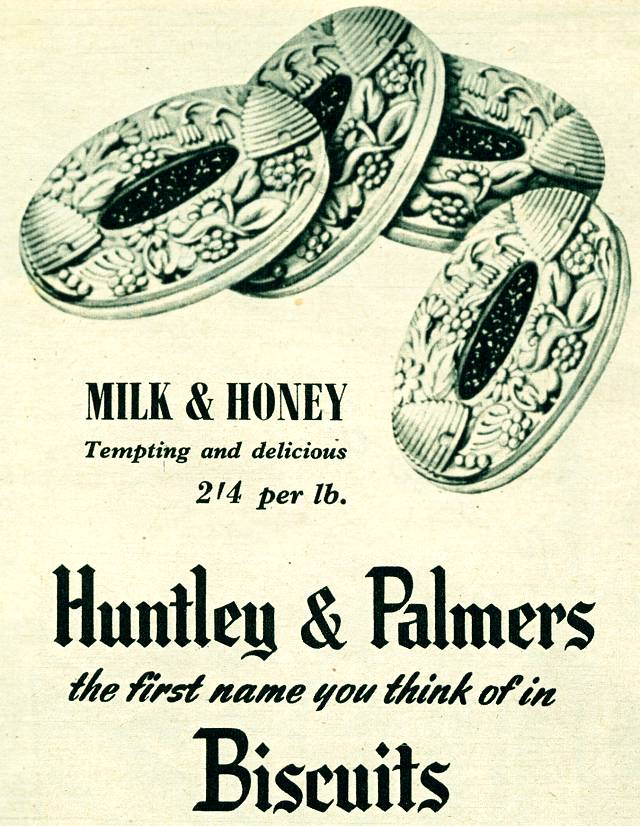
Every year, for most of my school days, I gave up biscuits. What a pleasure it was, over the Easter weekend, to indulge in not only a chocolate Easter egg from my mum and dad but a couple of biscuits with a cup of tea. I remember one year, when I was old enough to go to the shop on my own, my mum gave me some money (it would have been approximately a shilling – about 5 pence in current money)) to choose my own packet. My current favourites at that time were called Milk and Honey and were a bit like Jammy Dodgers and that’s what I chose.
This ad says they were two shillings and fourpence per pound. A standard packet is about eight ounces.
One Lent, when I was about ten, I gave up sugar in tea. Within days I found I preferred it and still take it sugarless. In comparison, my mum gave up taking sugar in her tea every Lent for her whole life. You would have thought that by the end of six weeks she would have got used to the sugarless drink. Oh no! Every year she spent six weeks disliking the taste of every single cuppa and breathing a sigh of relief when she first allowed herself a cup of tea with sugar in.
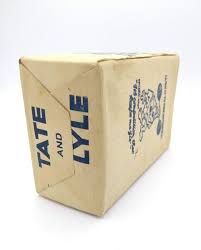
A 1950s pack of sugar. I’d forgotten how different they were!
My sister often gave up sweets for Lent. One year (or maybe she did it more than once and kept it quiet?) she gave them up as usual but every time she was offered one she would take it and pop it in a tin in her bedroom. These were all saved until, when Lent ended, she had a nice little collection to munch her way through.
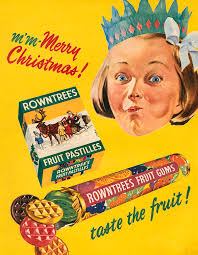
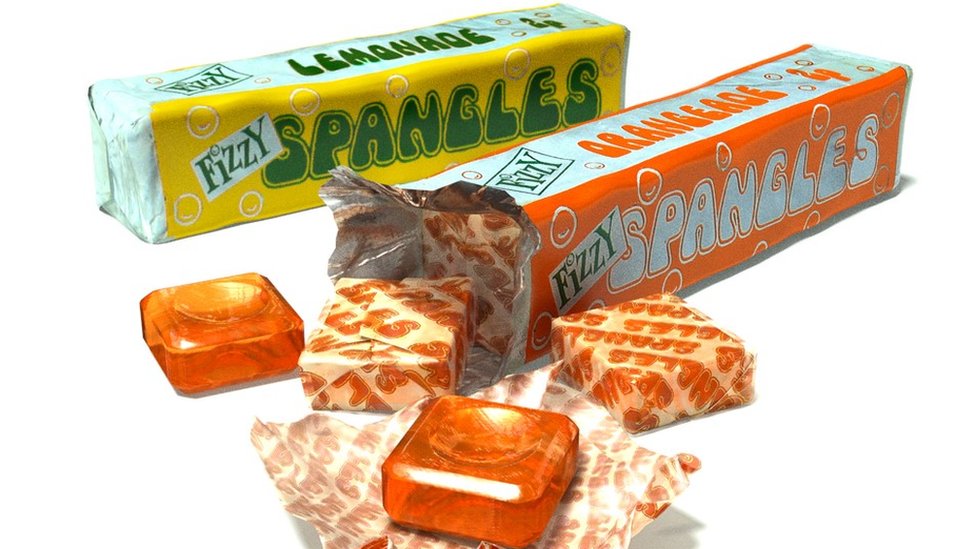
Some examples of the kind of sweets which might have been saved in my sister’s tin – with apologies to her for telling the tale!)
As always the images used, in order to add a bit of atmosphere to the post, are sourced from the Internet. I make every effort to avoid infringing copyright but if anyone objects to my use of an image I will remove it.
This rather odd title will make sense (I hope!) once you read on. The number of games which can be played on phones and other devices now is unlimited. One can play with other people or alone. Most of the games are recent creations and new ones are appearing all the time – so I’m told. There are complex, role-playing games but at the other end of the scale there are on-screen jigsaws, patience, Scrabble, crosswords etc etc.
When we were young, in the days before electronic devices, we were never without games to play whenever we couldn’t be outside. There were board games, card games, jigsaws, pencil and paper games and verbal games. I’ll look at each category in turn.
Boards Games
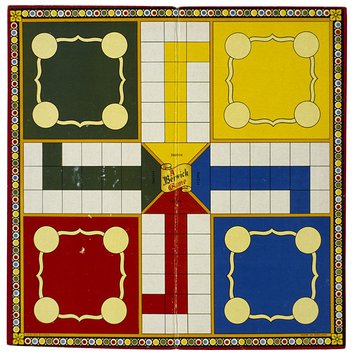
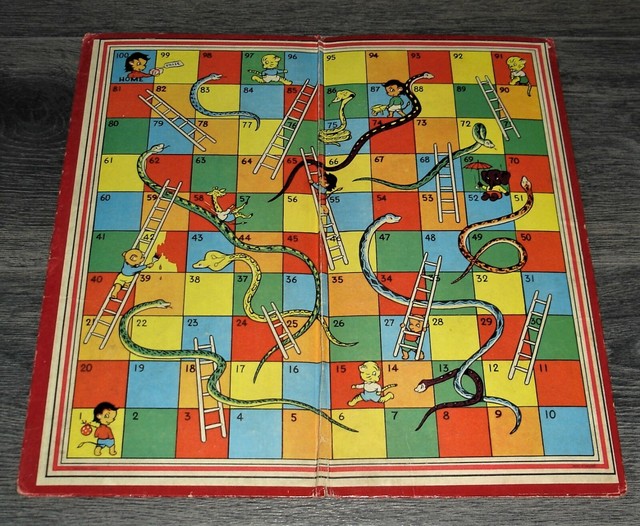
As slightly older children, I remember us playing Monopoly and Cluedo but when we were very young the games I remember best are Ludo, Snakes and Ladders and Draughts.
Card Games
The favourites in our toy cupboard were Snap, Old Maid and Happy Families
Jigsaws
Such hours of fun! We began as young children with the 8 or 10 piece ones and moved up to more complex ones as we became older and better at them.
Pencil and Paper Games
We could have hours of indoor fun with scrap paper and pencils. Hangman was a favourite as was Noughts and Crosses. We had many laughs over games of Consequences.
Verbal Games
I-Spy is probably the best known one of these. Another alphabet game we used to play was ‘I packed my case and in it I put a/ an .. ‘. There are different versions of it but whatever the words used in the opening sentence, the game then goes on like this. The first person completes the sentence with an item which begins with A. Taking it in turns, the next person has to think of an item beginning with B but also has to include the A word. And so it goes on. If you get to Z that person has to complete the sentence with all 26 items in the right order. Good memory training!
All images gleaned from Google Images and Wikipedia. I make every effort to use only pictures which I believe I am at liberty to use. If anyone feels that I have inadvertently infringed copyright please contact me and I’ll remove the offending image.
Many thanks to Liz, a follower of this blog, for suggesting this post after reading the last one on new words.
Gumption – This was a term for common sense. ‘Use your gumption.’ ‘She’s got no gumption.’ were the kind of things heard in conversation. My mum even used to shorten it when exasperated ‘Where’s your gumpsh?’ would be the sort of thing we’d hear her say. You can’t photograph common sense so here’s an ad for a household cleaner which was very popular here in the 50’s and was called – Gumption! I haven’t seen it for donkey’s years. So I had a rummage on the Internet. It’s long gone from here but is still available in Australia. I found a big tub of it for sale on Ebay. It was £4.13 to buy plus £23.06 postage.
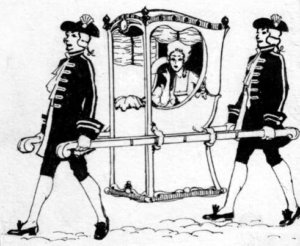
Cheerio – We all know there is a cereal called Cheerios. Cheerio hasn’t completely disappeared as a word but is much less heard than in the 50s. Cheerio! for goodbye was very common back then. Even though it’s not completely dead and is still used, albeit less so, I’ve put it in here because I wanted to tell you how it originated. It was used first in London in the 17th Century and came about because when rich people wanted to hail cab, which was actually a sedan chair, they would call out of a window ‘Chair, Ho!’ The sound of this call became associated with leaving on a journey and evolved into Cheerio!
Drawers – No, not the ones you keep your underwear in. This is your actual underwear. In Victorian times knickers/ pants/ underpants were known as drawers. It was still in use by older people when I was a child and now is probably only ever used humorously – by those who remember what drawers were. I won’t bother with a picture for this one!
Cravat – The word and the item still exist but I can’t remember when I last saw a man wearing one or heard the word spoken. Here is the lovely Michael Caine sporting a jaunty number.
Natty – My mum used to use this. I never hear it now. The Oxford English Dictionary defines it as ‘(of a person or an article of clothing) smart and fashionable.’ If we were out somewhere and saw a gent in a loud or bad taste suit she would quip, quietly, ‘That’s a natty bit of gent’s suiting!’ Her dad, my grandfather, was a tailor so perhaps she got the expression from him.
Trews/ Slacks/ Flannels – All words for trousers, all now somewhat archaic. Slacks were more casual and could be men’s or women’s. Standard grey men’s trousers, usually worn with sports jackets or blazers, were always called flannels. Flannel is a soft woven fabric, of various fineness, originally made from carded wool or worsted yarn, but is now often made from either wool, cotton, or synthetic fibre.
Wireless – Once a noun, now an adjective. We still use the word wireless and it now describes an electronic connection made without wires. When I was a child in the 50s, the radio was never referred to as a radio. It was the wireless.
Gramophone – This was the first term used to describe a machine which played discs. This then morphed into record player and later into deck.
Radiogram – This was a radio and record player (gramophone and wireless) combined and cleverly disguised as a sideboard. Some also had a space for storing records. My mum and dad bought one when I was 8 or 9 and I thought it was amazing!
HP/ Never-Never – From the 1930s, if you wanted to purchase goods but couldn’t afford to buy them outright, there was the option of a hire-purchase agreement also known as the never-never. Credit cards, standing orders and direct debits didn’t exist.
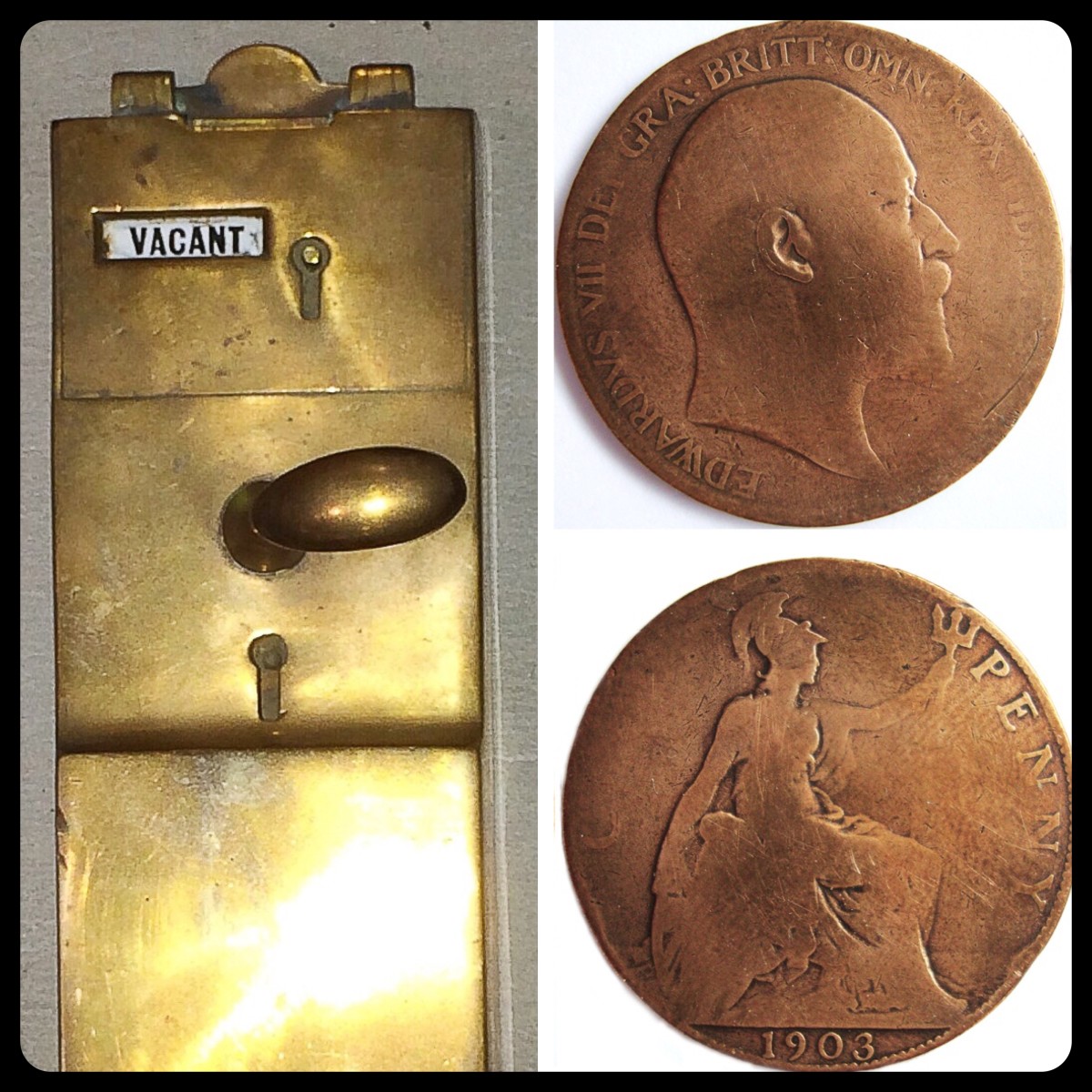
Florin, shilling, sixpence, threepence, farthing, halfpenny, ten bob note, crown, half-crown, guinea etc – these are all words from our old currency. When we decimalised we only kept the pounds and the pennies (pence). When I was very young, and for many years before that, public toilets always had a slot on the door which took one penny. This gave rise to the very British expression ‘spend a penny’ which isn’t heard as much now.
Shooting Brake – These quirky vehicles were popular in the 50s and for some reason were known as shooting brakes. Basically an estate car with a wooden trim, they had a very distinctive look.
Wellington Boot/ Gumboot/ Galoshes – now always just called wellies. At some point in the early 1800s Arthur Wellesley, then Viscount Wellington, asked his shoemaker, Mr George Hoby of St James’s Street, London, to make a boot which was easier to wear with the new, fashionable, tighter-fitting trousers. Hoby removed the tassel and cut the boots lower to make them more comfortable for riding. Meanwhile, in 1856 the Edinburgh-based North British Rubber Company had started to manufacture Britain’s first rubber or ‘gum’ boots. With the name of the duke still retaining a patriotic pull on consumers, these new boots were soon also renamed Wellingtons in Britain. Their popularity did not become widespread until the First World War, when in 1916 the company was commissioned to produce millions of pairs as standard winter kit for ordinary soldiers, to prevent ‘trench foot’, a medical condition caused by prolonged exposure to damp. At the end of the war, soldiers brought them home and introduced these extremely practical items of footwear to farms, gardens and allotments all over the country. A century later, music festivals and fashion catwalks are still benefiting from this wartime legacy.
As always, I need to say that all my images are sourced from the Internet using filters in the hope that I don’t infringe copyright. If anyone objects to the use of any image please contact me immediately and I will remove it.
Credit to Wikipedia, English Heritage, Pinterest, OED, Historic UK
This follows on from the last blog post. In that one I looked at the TV programmes aimed at young children and timed to fit in between getting back from school and the family meal. After the six o’clock news there was another slot where programmes were shown which could be enjoyed by whole families before the kids went to bed. Pre-watershed we would say now! Here are the ones which are etched into my memory which were shown in one of those two slots or on Saturday afternoon. Yes, there was some daytime TV on a Saturday! Mostly sport and some family entertainment.
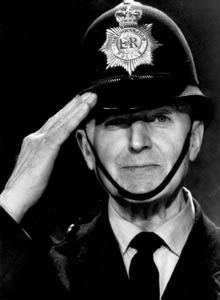
Dixon of Dock Green – Oh, how we loved this programme! I see now that it had already been running several years when we got TV and that it carried on into the seventies. Police dramas are big in TV now and this was one of the first. But it was so mild, so everyday, so genteel and polite! If you watched it – you’ll know exactly what I mean. Evening all!
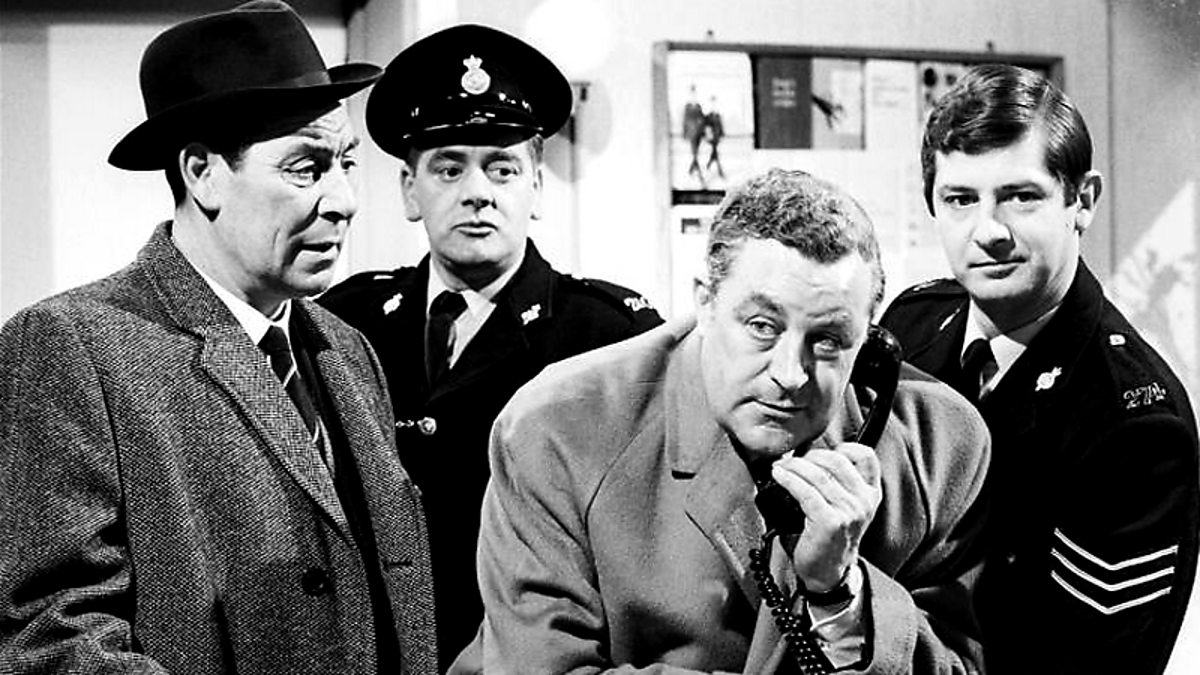
Z Cars – This was the second police drama in my life. For a while they ran concurrently. It was a bit more high speed and punchy – but still very tame compared with police dramas of today.
R.C.M.P. – A Canadian (obviously!) made series which ran for a couple of years in the early sixties, we loved this! I can’t now remember any of the characters or stories but we looked forward to every week’s episode.
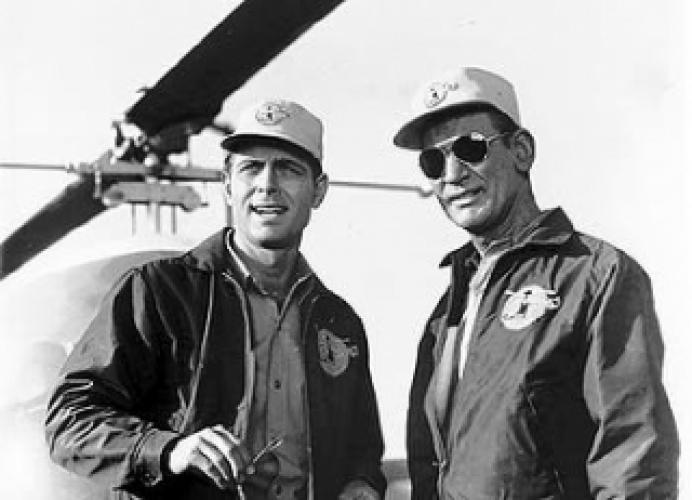
Whirlybirds U.S. – As favourite TV shows go, this one is in the top five for me and my siblings. Again, I don’t remember any of the actual adventures or the names of any characters but it left me with a lifelong love of helicopters.
Gary Halliday – This was British made and another HUGE favourite with me and my siblings. Halliday was a pilot for a commercial airline and flew to his adventures in an aircraft with the call sign Golf Alpha Oboe Roger George. He was assisted by co-pilot Bill Dodds. Their enemy was The Voice who was never seen by other characters, so that at the end of each series he could escape and reappear in the next. I remember one summer holiday when I, my brother and sister became Gary Halliday characters for days, maybe weeks on end. Even when we went inside for lunch or tea we built it into our role play. Our front porch was the cockpit of our aircraft.
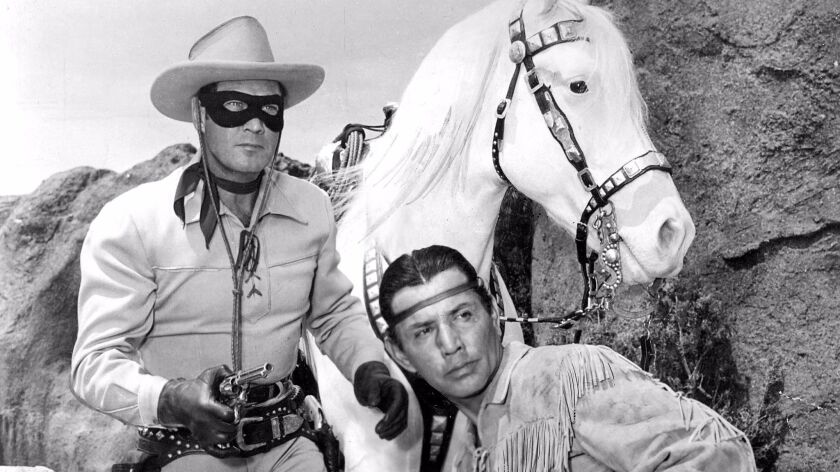
The Lone Ranger This was a US series which was launched in the mid 50s and arrived several years later here in Britain. The masked horse rider, the horse called Silver, the trusty Native American mate called Tonto – it was wonderful!
The Range Rider This was another US import of the late 50s / early 60s with a horse-riding hero. We loved this too but I must have loved the Lone Ranger more because I remember his horse’s name!
Emergency Ward 10 – Running from 57 to 67, this was the precursor to the current medical drama series we have on UK TV here now, Casualty and Holby City.
Dr Kildare – The US import which was the equivalent of Emergency Ward 10. The main doctor character was the impossibly handsome Richard Chamberlain.
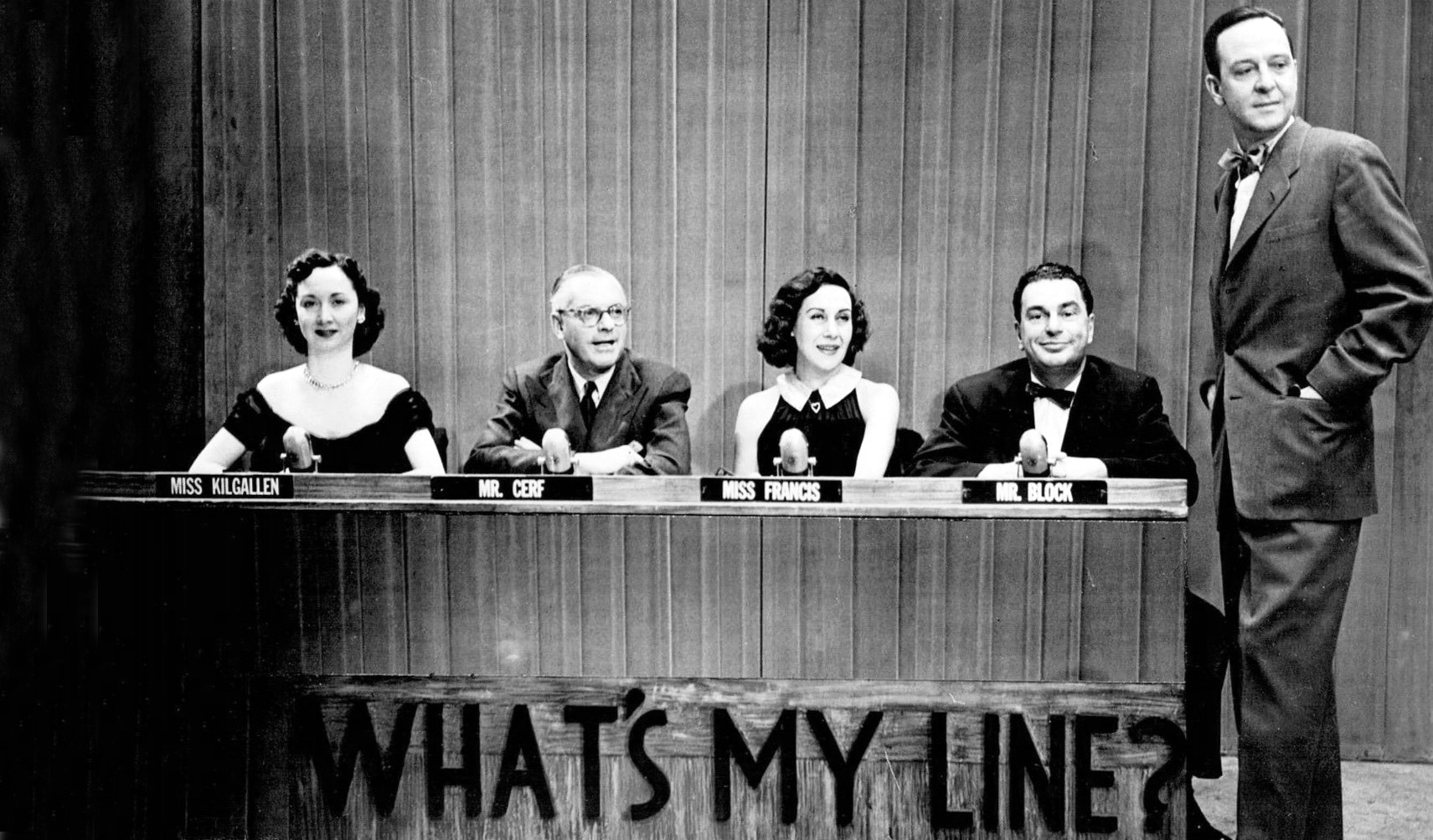
What’s My Line? – This was an early version of the TV panel game. Each week, a few guests mimed their job and the panel – the same people every week – tried to guess what they did for a living. My family absolutely loved it. I can still remember one of the mimes when a zoo keeper acted out the washing of an elephant.
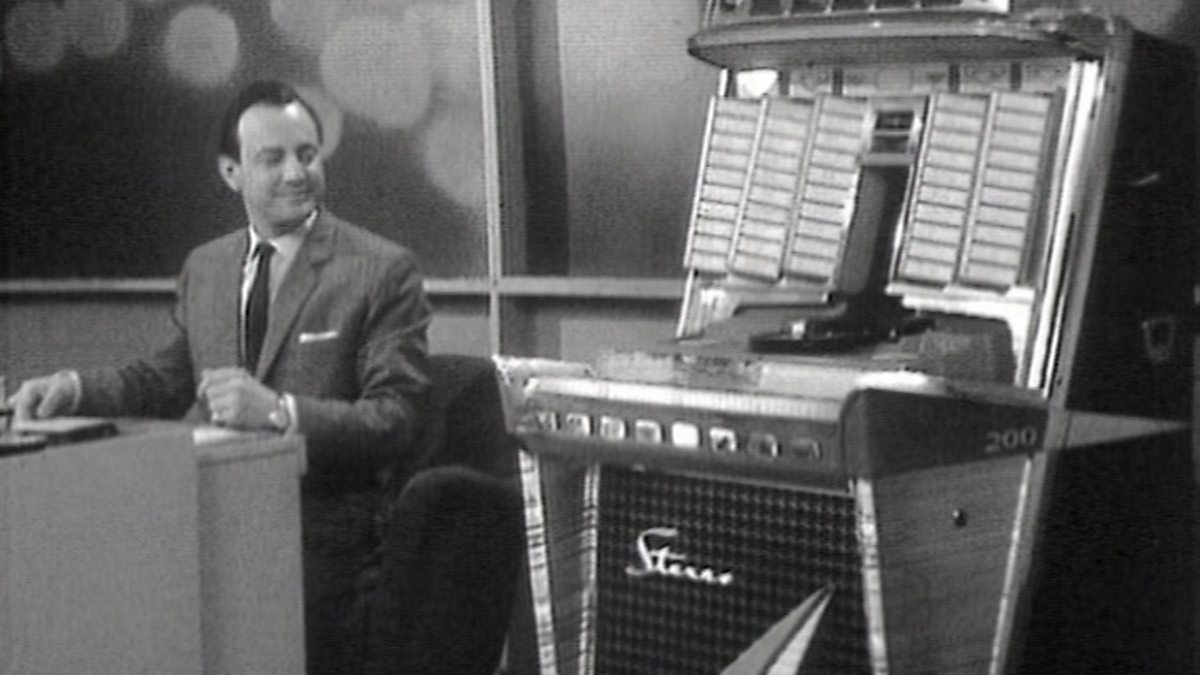
Juke Box Jury – The perfect programme for those early days of ‘pop’ music! I seem to remember it was on at around ‘tea time’ on a Saturday. We got to hear new singles and we watched the panel like or dislike them. It was a lot more fun than it sounds!
As always, if anyone objects to my use of any image sourced from the internet – as carefully as I can – please contact me so that I can remove it.
I have covered TV before but this time I’m looking purely at the children’s programmes I, my brother and sister watched in the very first few years of family TV. I was ten years old when we first got a television, in 1961. For several years we only had one channel – BBC1. Many people my age remember Muffin the Mule but he is not covered here simply because I never watched the programme. I have looked it up and it ran from 1946 to 1955 which was well before we had TV.
The first ones listed are the programmes made for children and shown in the slot which covered after school until the 6.00pm news or, in the case of Watch With Mother, just after lunch. The dates show the years they were shown on British TV.
Noggin the Nog 1959 – 65 Peter Firmin was inspired to create the characters by a set of 12th century Norse chess pieces – discovered on the Isle of Lewis – that he saw in the British Museum. The cartoon was written and produced by Oliver Postgate, who was also a narrator. Firmin and Postgate produced many children’s programmes for the BBC, including Pogles’ Wood, Ivor the Engine, Bagpuss and the Clangers.
Captain Pugwash 1957 – 66 This was a delightful cartoon about a Pirate ship called the Black Pig and the pirates who sailed in it. They had plenty of adventures, none of which I remember now, but the theme tune and the cartoon characters I recall with great pleasure.
Watch With Mother 1952 – 75 This was broadcast at 1:30 pm each day and comprised:
Picture Book – Mondays, from 1955
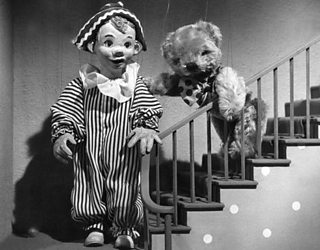
Andy Pandy – Tuesdays, from 1950
Flower Pot Men – Wednesdays, from 1952
Rag, Tag and Bobtail – Thursdays, from 1953
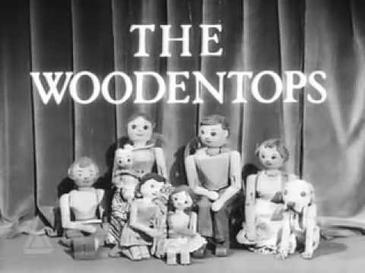
The Woodentops – Fridays, from 1955
It was aimed at pre-school children but I remember it so well and how much we loved it – even though we had no TV until I was ten. I think we must have watched it in the school holidays or if we were ever home from school poorly. TV didn’t start until 4 pm when the children’s programmes started. Watch With Mother was the only daytime TV back then so it was a novelty!
Crackerjack 1956 – 84 Looking this up, I was amazed to see that it ran for nearly thirty years. I remember it being a ot of fun and that the children who were guests on it seemed to win a lot of prizes. I also remember that if they got a question wrong they got a cabbage instead.
Sketch Club 1958 – 61 We loved this programme! It was hosted by a man called Adrian Hill and he gave tips and hints on how to draw and paint. I have looked him up and found that he served in the Army in WW1 and was the first artist commissioned by the Imperial War Museum to record the conflict on the Western Front. After WW1 he worked with returning soldiers encouraging them to draw as part of their recovery. He also helped set up a scheme whereby works of art were loaned to hospitals across the country. He believed that art activities and art appreciation greatly assisted the recovery of those injured and traumatised by the war. He is credited with coining the term ‘art therapy’. I knew none of this when I watched his programme but I loved Sketch Club.
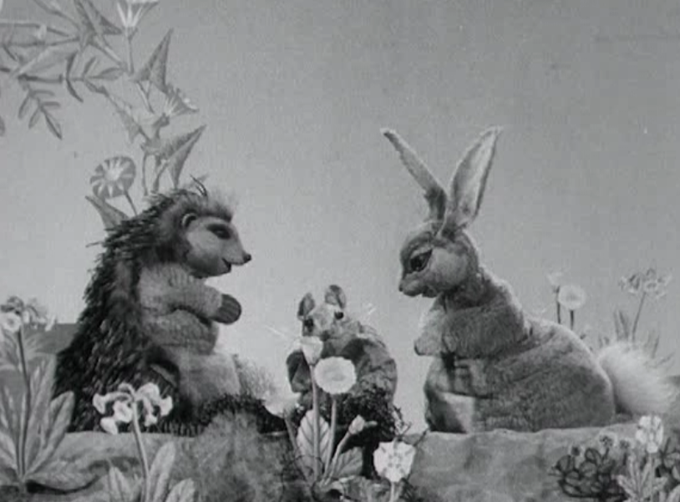
Tales of the Riverbank 1960 – 63 Everyone my age growing up in Britain in the 1950s and 60s remembers this programme, the voice of Johnny Morris and the beautiful theme tune – which I now know is Andante in C by Guiliani.
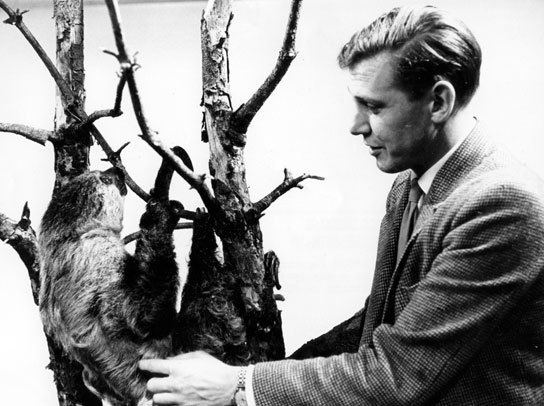
Zoo Quest 1954 – 63 This was Sir David Attenborough’s first TV programme. I remember loving it and thinking he was wonderful – he still is! I loved seeing all the different animals and I seem to remember they were often in Madagascar which I hadn’t heard of until watching Zoo Quest. Doing my research for this post I have learned that the programme was all about a team from London Zoo on a mission to find and capture animals to bring back to the zoo. Wildlife programmes are very different now with the emphasis more on observing and preserving than capturing!
I was going to list some of the early evening programmes we enjoyed (such as Dixon of Dock Green) but the post would be too long so I’ll cover them in a separate one.
As always, if anyone objects to the use of any of my photographs, sourced from the Internet, please contact me so that I can remove it.
Welcome to my blog! I am an academic historian of medicine and the body, and 2014 AHRC/BBC 'New Generation Thinker'. Please enjoy and let me know what you think. All content is generated by AW and not AI!





















 Childhood Memories of growing up in the 1950s and 1960s.