Films.

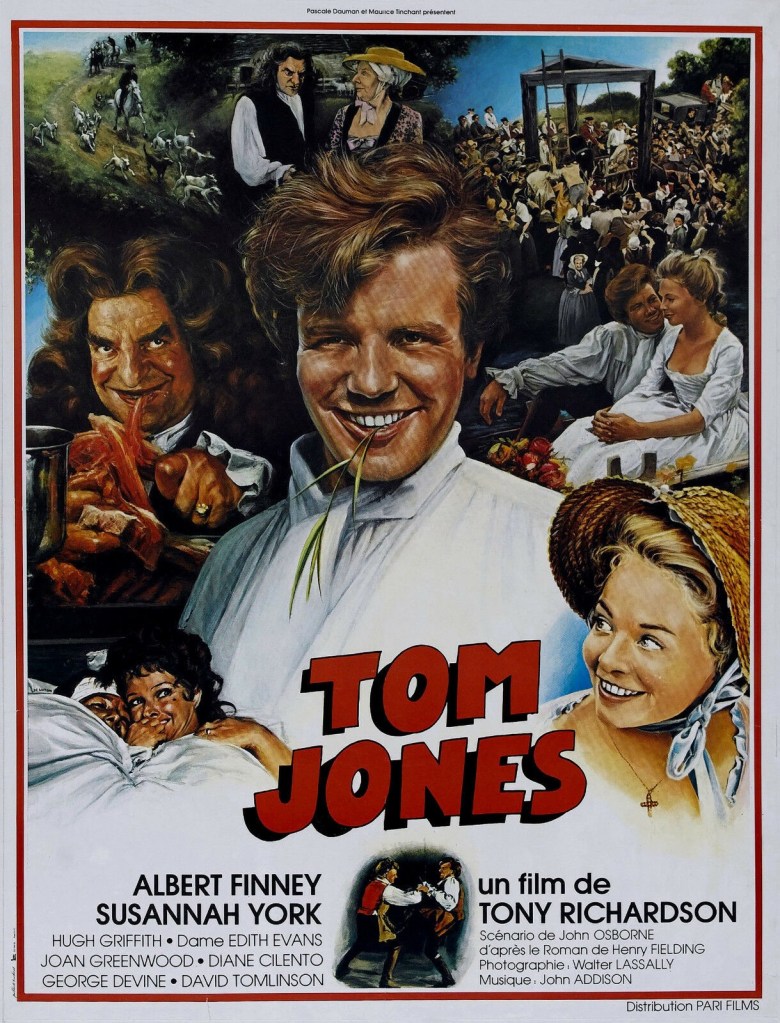
Until I was 13 we lived in a tiny village. Trips to the cinema were occasional, very exciting treats. These happened when we were away on holiday and also in our nearby small town, five miles away, in a very small independent cinema in a converted chapel. The man who ran it used to get the big films of the time – a year or two after they’d been shown in the big towns. We didn’t mind waiting! Occasionally, when a really good family film came to our town we’d get in the car as a family and go and see it. I remember us going to see Swiss Family Robinson and the cinema was absolutely packed with people standing and sitting on windowsills. It was the same when Tom Jones arrived.

When I was a teenager, and we’d moved to the town, I would go weekly to the cinema with my friends. We didn’t mind what we saw! The most popular, of course, were the ones we’d read all about in magazines like the Bond films, Georgy Girl, Alfie and Ben Hur.

Cinemas in those days had just one screen, although many town (not ours!) had more than one cinema. There was always an A film, the one you went to see, plus a B film which was shown first. In the intermission the ice cream vendors walked down the aisles with their trays of drinks, tubs and choc ices. There were adverts played in the intermission. In my small home town the ads were stills promoting local businesses, particularly the coach company the cinema proprietor and projectionist drove for in the daytime. People were allowed to smoke in cinemas, and a huge proportion of the population smoked. 
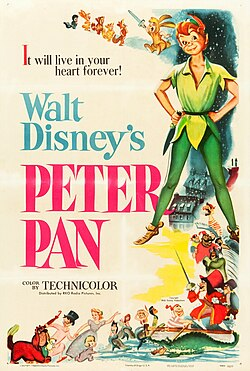
Apparently, I was taken to see this when I was about two years old. I don’t remember the occasion!
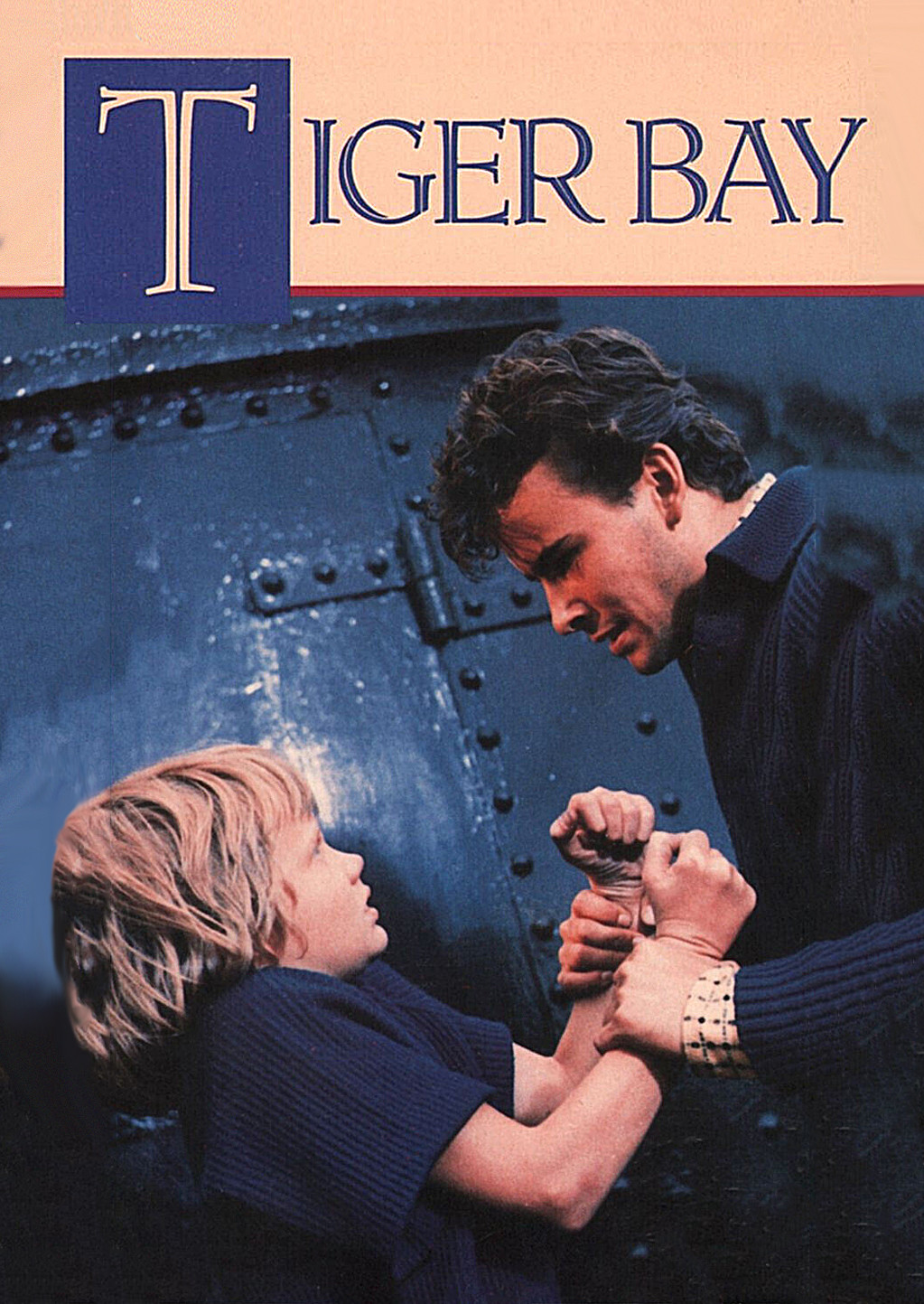
My grandmother took me to see this in Cardiff when I was staying with her one summer. It’s set and filmed in Cardiff which is probably why she was keen to see it. I see now that it was a crime film so I was probably far too young to understand it.
Our little cinema was crammed for the showing of this in around 1964, a year or so after release.

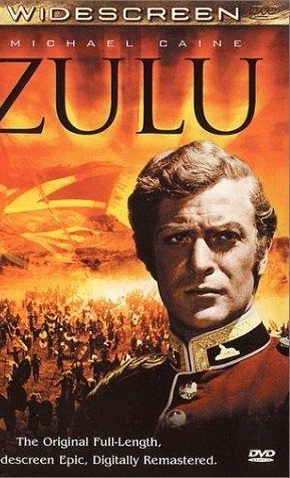
For both Zulu and The Sound of Music, we took a day trip to Cardiff to see them when they were still new.

TV

Once we had television, in the early 60s, we could watch old films at home. In black and white and on a very small screen!

Who could have imagined that by the 1980’s most of us would have VHS recorders and would be renting videos? Or that we would race on from there through DVDs to streaming? Even more so, it would have been impossible back then to imagine being able to watch films and TV on pocket-sized gadgets. These gadgets are known to us as phones but they bear no resemblance whatsoever to the early phone of the 1950s, either in appearance or capabilities.

Images courtesy of Google Images. Facts double-checked through Wikipedia. I make every effort to avoid infringing copyright. However, if anyone objects to any of the content in my posts get in touch directly with me and it will be removed.
Words and phrases

Imagine that a time traveller popped up from the 50’s and 60’s who had somehow missed the decades between then and now. Rip Van Winkle – remember that story? Apart from the very obvious changes in buildings, shops, technology, instant communication etc etc, I think there are many words and phrases which would baffle them in conversation. Here is a very small selection.

Family

When I was starting my family in the early eighties, nobody had events called baby showers. I’m not sure when the idea first appeared here in Britain but it’s certainly massive now. When my children had a friend come to play or, when a bit older, had a friend come to stay the night, these were not called play-dates and sleepovers.

Music

Back in the 50’s and 60’s we had classical, jazz, blues, music from films and shows and rock and roll. In the early 60’s we saw the emergence of pop. Now there is a plethora of musical genres. Garage, hip hop, grime, dub, Indie … to name just a few!

Miscellaneous

The world of famous people has changed enormously, largely due to the new ease of communication. Some words which would bewilder a time traveller from the 50’s and 60’s are fashionista, paparazzi, celeb.

In the 1950s we had newspapers and some people had televisions. Now we have podcasts, sound bites, boxed sets, binge watching,

Back when I was a child ‘environment’ was a word we rarely heard and we never used expressions like ‘saving the planet’ or ‘good for the environment’, plant-based, eco friendly, flexitarian etc.

And finally . . .

Mindfulness, exfoliate, click and collect, chip and pin, glamping, fatbergs. And many, many more.

Note. This is my own work, written from my own memories and opinions. Credit to Wikipedia, Google, Google Images used for fact-checking. I make every effort to avoid infringing copyright. However, if anyone objects to my use of any particular image, please contact me and it will be removed.
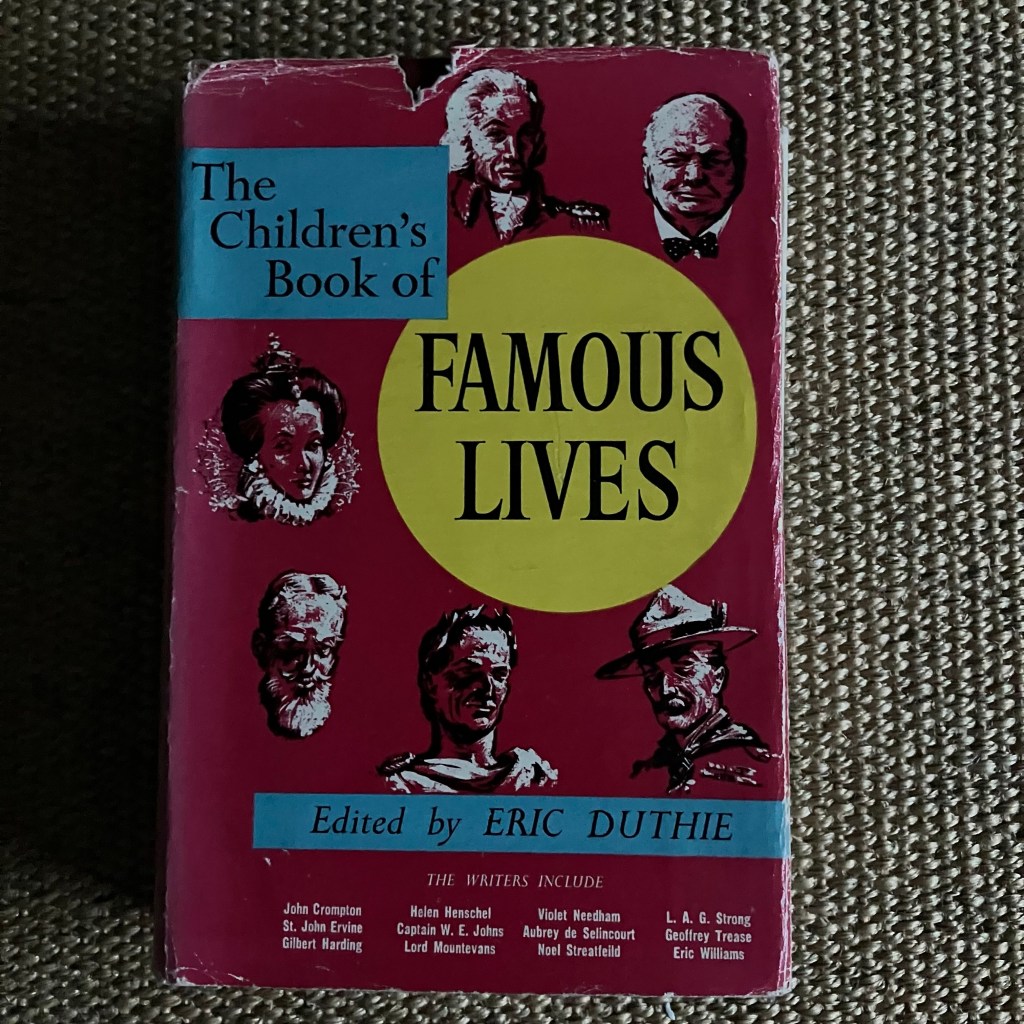
Jewellery

When I was a child men only ever wore a wristwatch and sometimes a signet ring. Rarely a wedding ring. Women, however, had a few more adornments. A married woman wore a wedding ring and an engagement ring. Wristwatches for women were dainty and pretty.

Most women in my childhood didn’t have pierced ears. When dressing up and going out they would sometimes wear a pair of clip on earrings. These were usually either diamanté or pearl.

Pearls (real or fake) and other beads were very popular as necklaces, mainly for occasions.

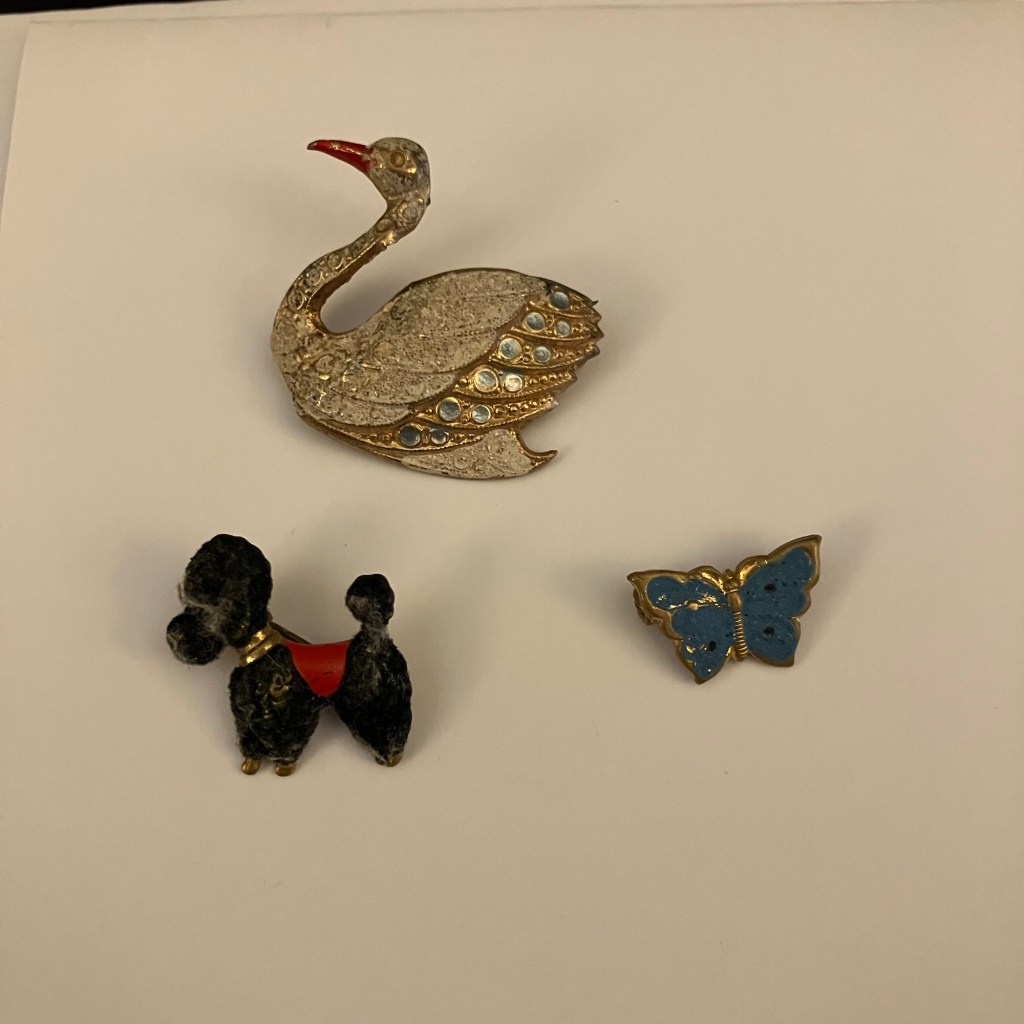
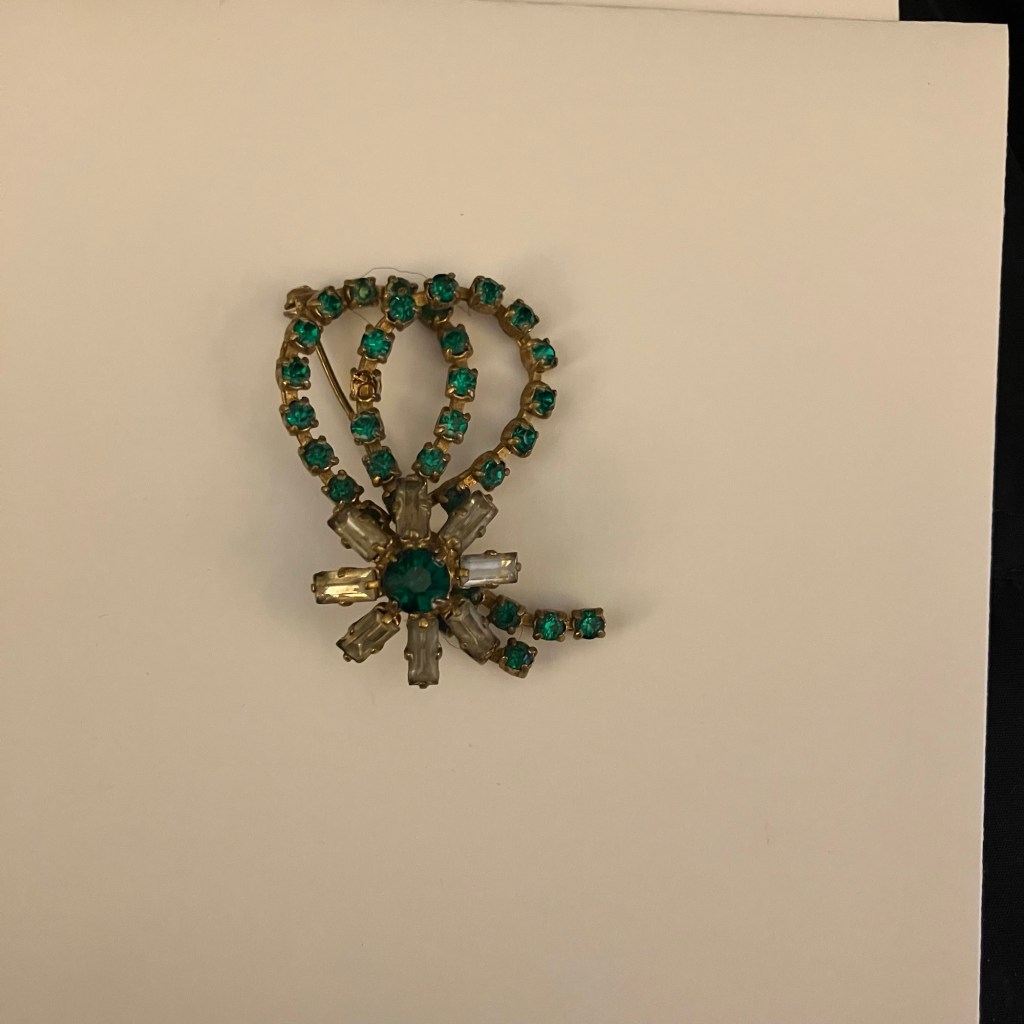
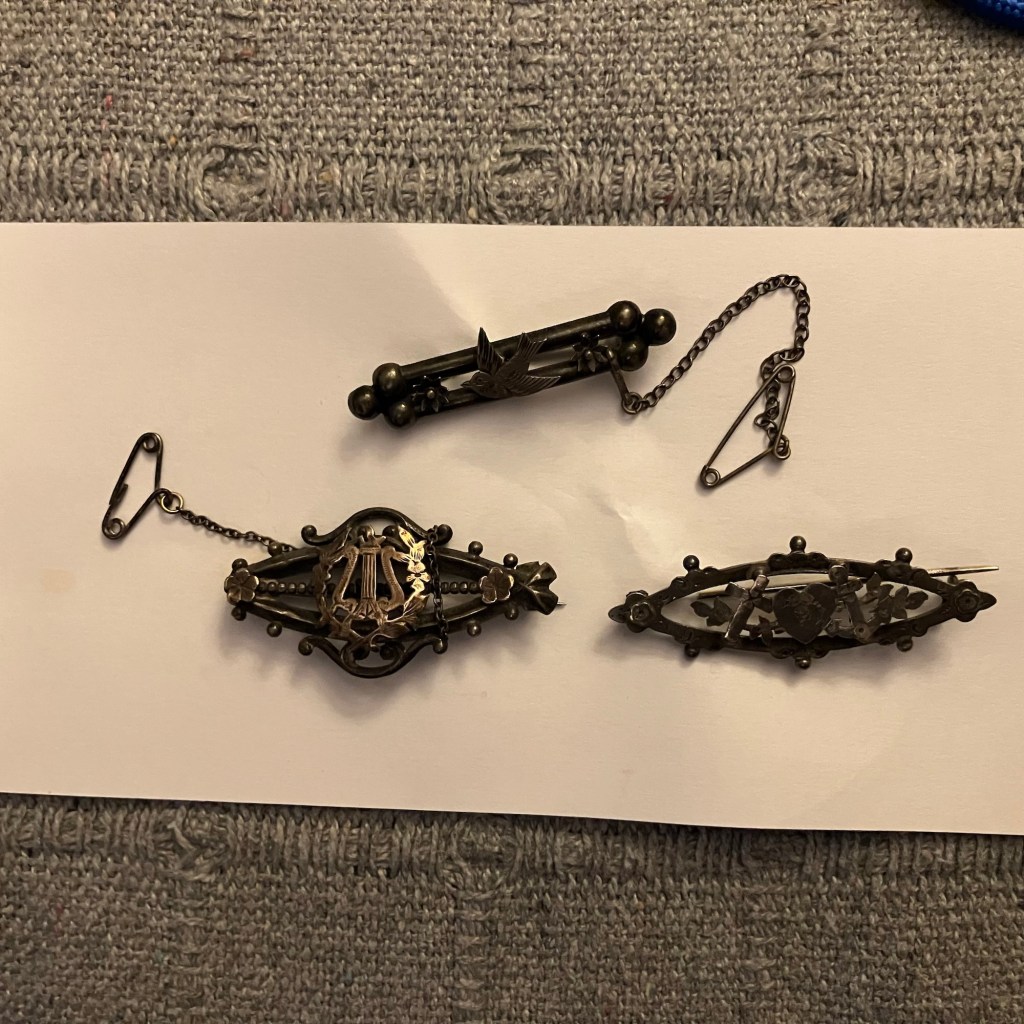
An item which is less often seen now is the brooch. Neither my mum nor my grandmothers ever left the house in a coat or a jacket without a brooch on the lapel. Even girls wore brooches on coats and they were a popular gift to buy for sisters, friends, mothers and grandmothers. I have a few brooches which were my mum’s and my grandmothers’ and also a few of mine from when I was a young girl – because young girls wore them too.

These were mine when I was a girl.
My grandmother loved this brooch and wore it a lot. It’s from the late 1950s.
Three very old brooches which my other grandmother gave me (she knew I loved old things with a story!). They had been in the family since Victorian times so were probably my great grandmother’s.

At one time one of us, probably me or my sister rather than my brother, had been given a brooch making kit as a present. Crafting kits were very popular back in the 50s! It was a kit for making brooches out of felt shapes and included a brooch pin to put on the back. We made my grandmother one and she proudly pinned it on the lapel of her coat and there it stayed for ages. We thought it was beautiful, it was probably awful!

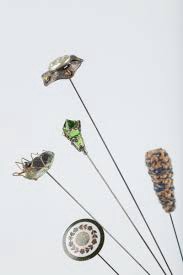
On the subject of grandmothers, neither of mine ever left the house without a hat on. They were both born in the 1890s so were Victorian babies. Their hats always had a hatpin or two in them. I’ve looked hatpins up and I found that ‘They were a fashion necessity in the late Victorian and Edwardian eras.’ In earlier times women always had long hair, not short and wore it piled up on top, never loose. The hat pin went into the fabric of the hat, through the pile of tied up hair and out the other side. This kept the hat in position and stopped it blowing away in a breeze. But they were also a form of jewellery as the head of the pin became more and more ornamented. They are now quite collectible, especially the ones with precious and semi-precious stones and pearls.

Pierced navels, lips, eyebrows etc were yet to come!

This is a personal blog and not a historical document. I check facts thoroughly but my posts are mostly my recollections. Credit to Google, Google Images and Wikipedia. I try to avoid infringing copyright but if anyone objects to an image being used please contact me and it will be removed.
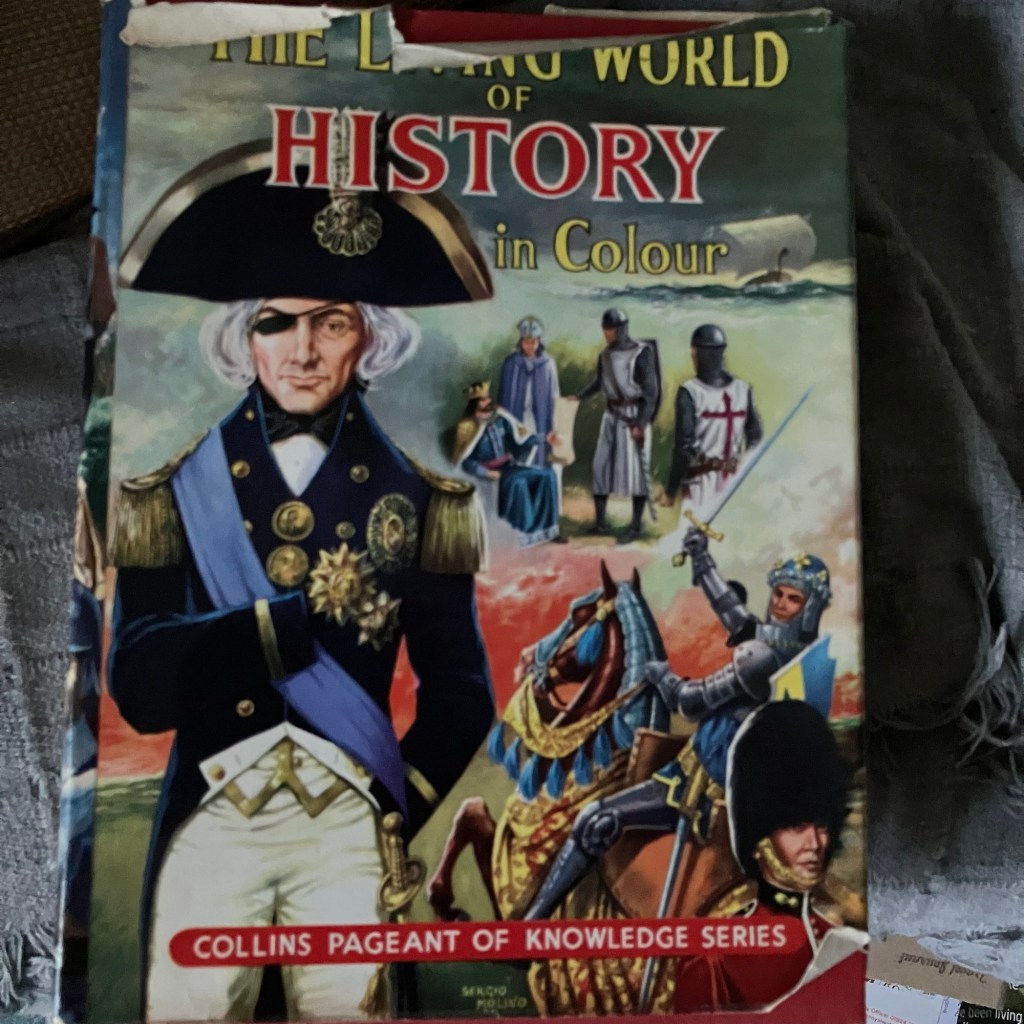
Christmas in the 50s and 60s.

Merry Christmas to all who read this blog. Thank you all for stopping by. Here are some thoughts on how things have changed since I was a child.

Paper Chains

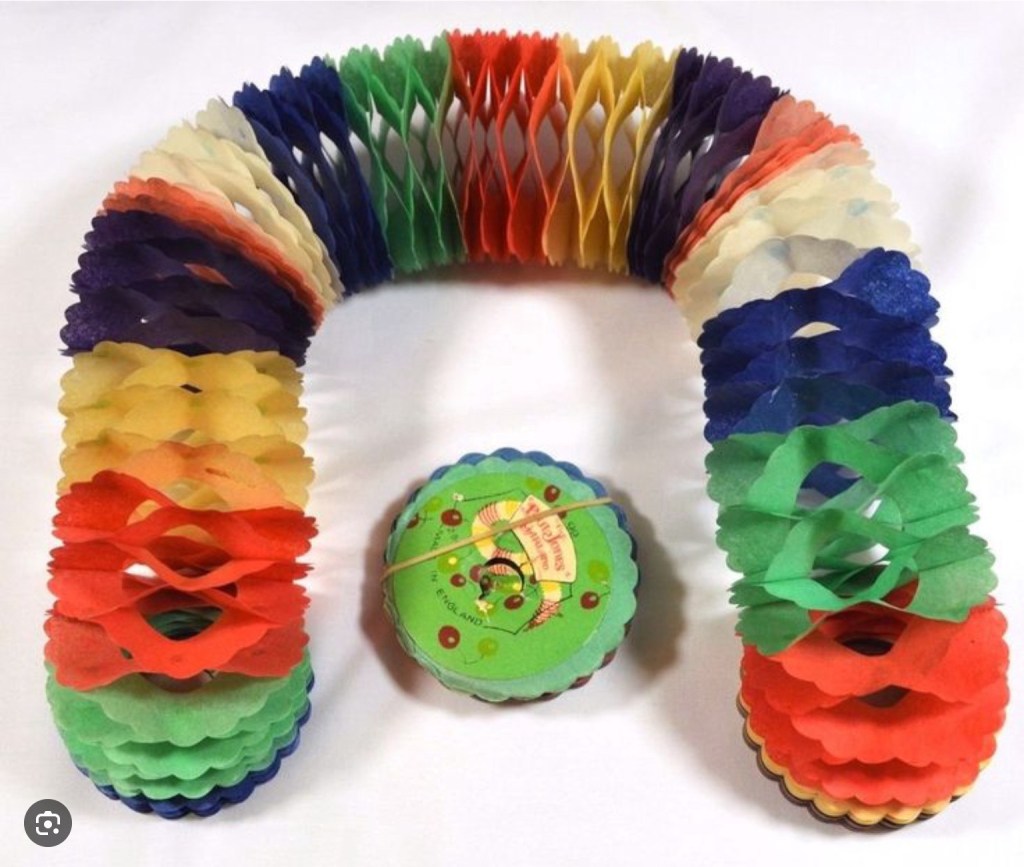
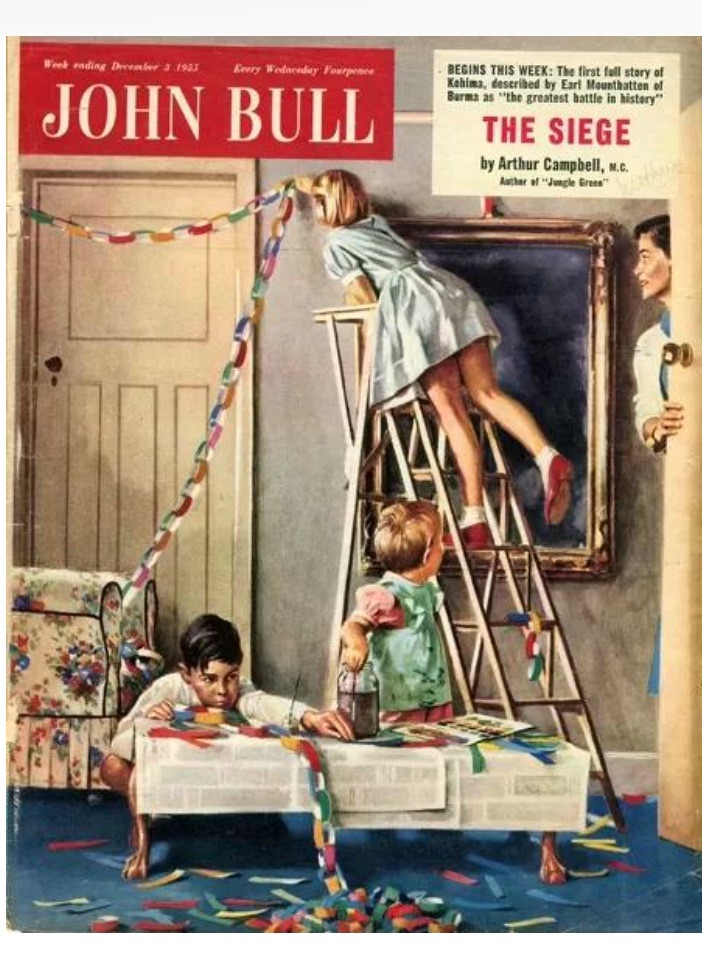
It seems to me that Christmas lights outside houses and in gardens get more popular every year. When I was a child the main focal point was the tree. How we loved helping to decorate it. I still have a few of the glass baubles from the 1950s which went on our tree every year. We also used to put holly and balloons up (not next to each other!). And then there were the paper chains which were pinned up in the ceiling and went from corner to corner. These paper chains would be carefully folded afterwards and saved for next year. You could also buy packs of coloured, gummed paper rectangles to make your own paper chains and we children loved doing that.

Christmas Day Post

There used to be a postal delivery on Christmas Day in Britain right up until 1960! It’s hard to imagine now. My grandfather was a rural postman with a round which covered a wide area of scattered farms and houses. Back in my dad’s childhood his father would be out all day on Christmas Day delivering cards. People used to send cards then to arrive on the day, like birthday cards. The family also went to chapel three times on Christmas Day so their Christmas dinner and present exchanging was always on Boxing Day.

Stockings

Children’s Christmas stockings were knitted ones. They now come in a huge variety of shapes, styles, sizes and materials. Ours were light brown woollen knee high stockings. A relative had knitted two pairs for my dad to wear under wellington boots when working outside. They were coarse and itchy so he never actually wore them and they were repurposed as Christmas stockings for his three children.

Circus on TV on Boxing Day

On Boxing Day there was always a circus on TV in the afternoon. We only had one channel when we first got a TV in 1961 so it was the circus or the circus! There wasn’t normally anything on TV in the daytime apart from the preschoolers’ Watch With Mother just after lunchtime. So watching television in the afternoon was a rare treat! TVs then gave out such a weak light that in order to see the picture in daylight you had to close the curtains.

Twelfth Night

The tree and decorations would be put up just before Christmas (not like now when they start appearing in November!) and it was considered extremely bad luck to take them down before the Twelfth Night, 6th January.

Father Christmas v Santa Claus

When I was little we never called him anything but Father Christmas. Now you rarely hear him referred to as that. I knew the name Santa Claus from Christmas songs on the radio but he was always Father Christmas then. I always preferred the pictures which showed him wearing a long hooded cloak. Other kids preferred the tunic, belt and knee boots image. It’s just down to personal preference.

Credit to Wikipedia and Google Images. If anyone objects to my use of a particular image please contact me and it will be removed.
Finding Things Out – Before The Internet

It crossed my mind recently that any time I want to know something I can reach for my phone, tablet or laptop. It wasn’t always so!

Humans are curious by nature. As infants we ask our parents endless questions. Next comes school and the teachers and the books on the shelves.

Parents

As toddlers, pre-schoolers and very young children, we assumed our parents knew the answer to everything. They could have told us anything and we’d have believed it. In fact, many adults have funny stories about being told daft things for fun – and believing every word.

Teachers

Once in school, children had another oracle to consult – the teacher. Up went the hand and “Please Sir/ Miss, how did……………?” and so on. Of course teachers didn’t know everything, any more then parents did, but very young children didn’t know that.

Atlases, dictionaries, encyclopaedias etc.

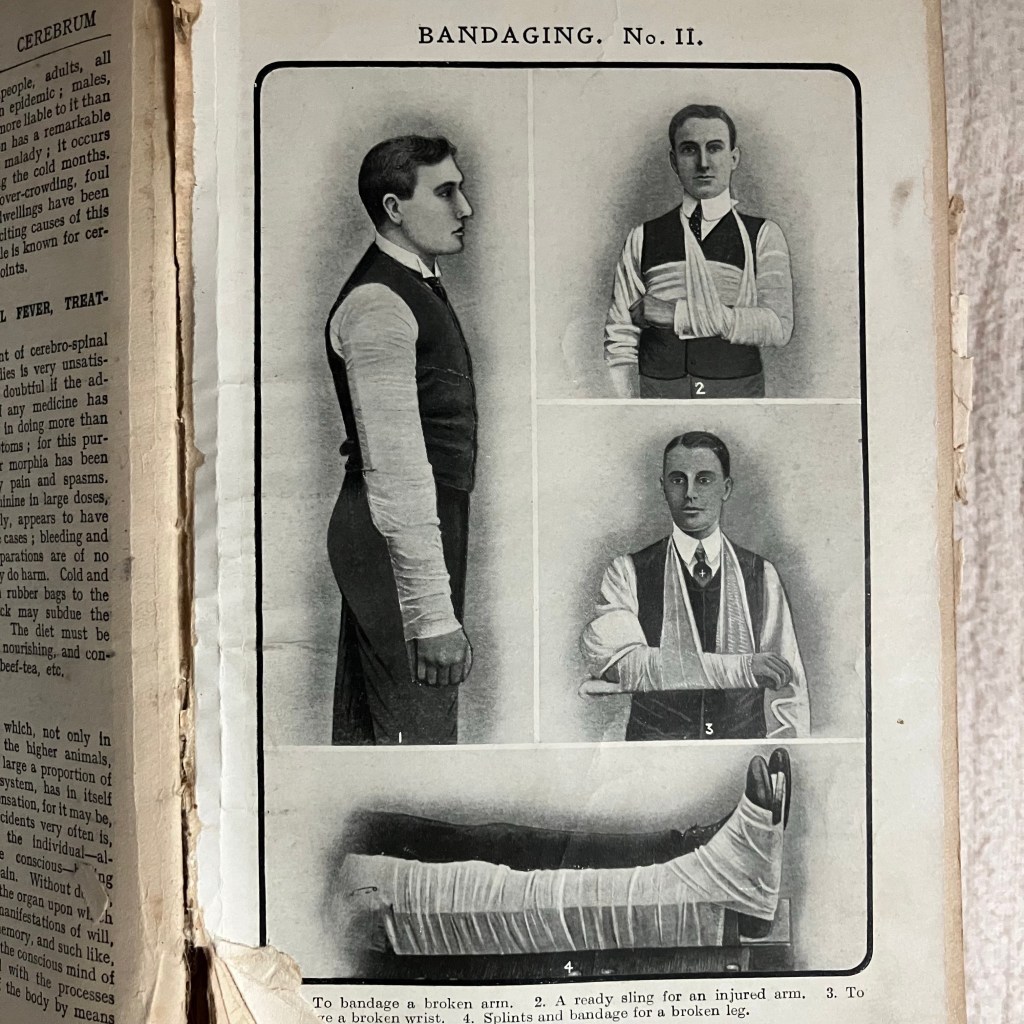
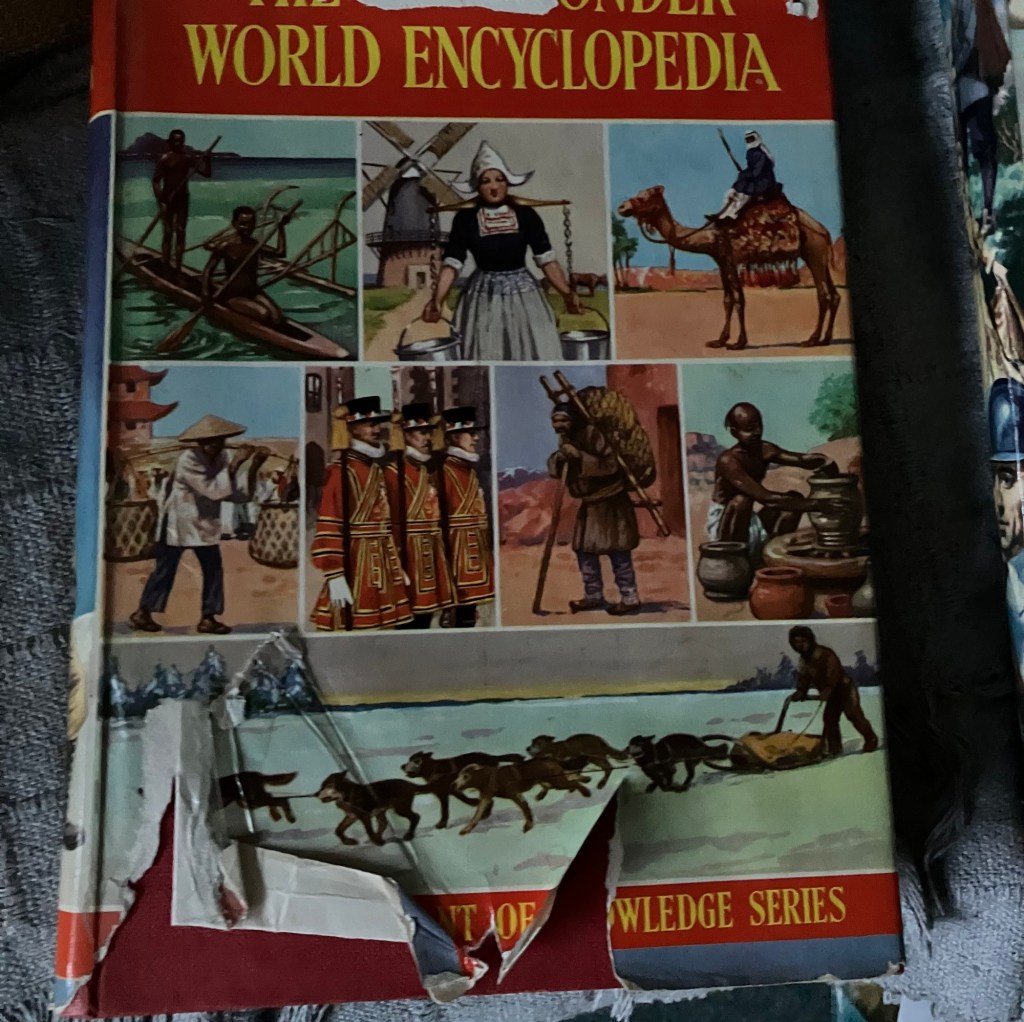
Once children became fluent readers, a whole new world opened up. Reference books were on hand in the classroom and most homes had a selection of books. A set of encyclopaedias was a popular thing to have. I know that’s how my grandfather collected his. These were often bought one at a time through a scheme, so I’ve been told. There would also be a Bible, a dictionary and often a world atlas. In many houses there would be a ‘Home Doctor’ book. I still have the two which were in my grandparents’ house. One is from the 1800s and the other from around 1920. They make fascinating reading!

Libraries

Libraries, particularly the reference sections, were a very important source of information. As an adult, and before the days of the Internet, I would make a note of anything I wished to find out more about and then take my list with me when I next had a chance to visit the local library.

Motoring Handbooks

For households with a car, and many didn’t when I was a child, the motoring handbook was a very useful travel guide. In the UK back in the 50s, we had the RAC and the AA. My dad favoured the RAC. With the membership the motorist got breakdown and rescue cover and every year received a new handbook. These held a wealth of information! There were road maps, of course, but also information on any town you were interested in, charts for calculating travelling distances and a full list of all registration letters so you could look up any car you spotted and find out which county it was from. We children had a lot of fun with that in the back of the car on holiday.

The Dawn of the Internet

This is a whole new era and not one I’m covering here. Now we walk around with ALL of the above reference material in our pockets. Children, even very young ones, are adept at looking things up on laptops in school and at home.

Finally, here are three of my own books from my childhood.

These are my own thoughts and memories, I am not attempting to write a history book!

The photographs are my own.

Changes Part 3

Here’s another quick-fire, no photos list of things which have changed since the 1950s and 60s.

Please note, these are taken from my own recollections. I endeavour to check facts and statistics before including them but this is a fun blog not a history book!

A cooked main meal was usually followed by a cooked pudding.

Before TV arrived, board games and card games were extremely popular family activities especially on winter evenings. We children loved playing games like Happy Families, Ludo, Snakes and Ladders. As a family we mostly played Cluedo and Monopoly.

A school uniform always included a hat – a cap or a beret with a school badge on it. Secondary school pupils all carried leather satchels. Sports wear was carried in a duffel bag. Primary schools didn’t have uniforms. Some private schools were the exception to this.

Swearing, even mild swearing, never appeared on the radio, on TV or (as far as I know), in books. In fact I didn’t even hear the ‘f’ word (which was passed around in whispered tones!) or the word shit until I started secondary school. At home we weren’t allowed to say bum we had to say bottom.

TV presenters, newsreaders etc never had regional accents.

People didn’t run or walk to keep fit. They walked to get places, they ran to catch things like buses, runaway balls or mischievous children!

A bar of soap was used for all personal hygiene. There were no shower gels or body washes. Neither was there any hair conditioner until the mid 60s. On the same subject, I rarely came across showers, except in school changing rooms, until the late 60s.

I hope this has triggered some memories!

Changes Part 2

I have had so many lovely comments responding to my Changes Since the 50s post. Thank you all! So I’ve decided to post another one. A simple list again, brief, no pictures. I hope it rings some bells.

Cars had no seat belts or reversing lights. They had three gears and you had to pull the choke out in order to start the engine – then remember to push it in again.

Most people smoked (80% of men and 40% of women in the early 1950s) and you could smoke anywhere. In cinemas, on trains and buses, in hospitals, cafes and restaurants.

Peaches, pineapples, salmon and cream came mostly in tins.

Nobody wore helmets when cycling.

Suitcases didn’t have wheels.

You answered the telephone with a greeting, your exchange and your number e.g. “Hello, Somewhereton 456”.

All children had ‘hobbies’.

Everyone wore vests, winter and summer.

The word vegetarian was rarely heard. Likewise vegan.

Most people did the football pools weekly.

You used encyclopaedias to look things up. A home set if you had one, in the library if not.

Changes since the 1950s – aka I’m back after a long gap!

First of all, apologies to regular readers (if I still have any!) for the long silence. I’ve had a very busy summer plus it gets harder to think of topics I haven’t already covered. So I thought I’d return with a simple list of things which have changed since I was a child in the 1950s. Just a list, no waffle, no pictures. Readers of a similar vintage to me will recognise them. Memories from other countries will be different. I can only speak for rural Britain which is all I knew.

We’d never heard of or seen duvets. Beds had a bottom sheet, top sheet, a few blankets, a counterpane (a word you never hear now) and in winter an eiderdown.

We didn’t have mugs, just cups and saucers.

TV programmes started in the evening apart from an hour in the middle of the day when there were programmes for pre-school children. Not everyone had a TV.

Nobody had washing machines, tumble dryers, microwaves or freezers. Many people didn’t even have fridges, phones or cars.

Gay meant happy, jolly, carefree. Mobile only meant able to move, not a phone. Remote only meant far away, not a TV control.

Most men wore hats outside and took them off indoors. Women usually wore hat and gloves to go out shopping, visiting or to church. They had winter gloves and summer gloves.

When you were unwell, even if it was just a cold, you stayed in bed. The doctor would visit and your mum would buy you Lucozade.

Toilet paper was hard and crunchy like baking parchment or greaseproof paper. There were no tissues. Everyone carried cotton handkerchiefs (hankies) which were washed on a Monday (wash day) and ironed on Tuesday.

Dustbins were metal and everything went in. There was no recycling apart from glass jars and bottles, many of which were worth a few pence when returned.

There were no charity shops but communities held jumble sales.

Children’s birthday parties involved presents, party games, sandwiches, jelly, birthday cake – and guests were not given a party bag to take home.

I could go on, but that will do for now. Hope you’ve enjoyed it and recognised some things!

Buying Music

The first form of music listening came from our earliest groups of people. This music was not considered organized as we might call the music we listen to today, rather, it used forms of clapping, drumming, and oral music with varying types of singing. 

Later, some of the more popular music appeared in churches. Many musical artists and writers began to write music as a response to God and to the church. It was used as a tool to unite people. 

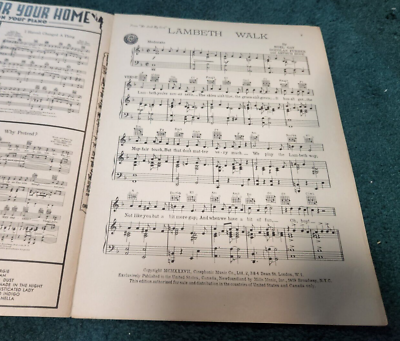
Throughout the centuries, people have enjoyed making and listening to music. Singing in the home was popular, often around a piano. With the coming of the music halls in Victorian Britain, popular songs were becoming well known and sung. The first form of bought music was sheet music. As the popular songs of the day became known people would buy the sheet music and play in groups in homes, pubs and community spaces.

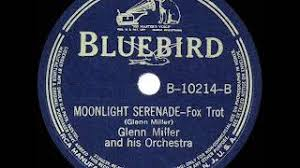
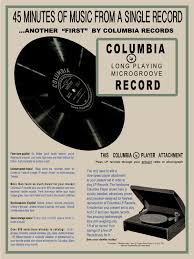
In the late 1800s, Thomas Edison invented the first record player known as a phonograph. By the 20s and 30s gramophones, later known as record players, and the black discs revolving at 78 rpm became more readily accessible to the public. The record player and records themselves evolved through several different stages from the 78’s to the newer, smaller 45’s (singles) and the 33rpm LPs later known as albums.

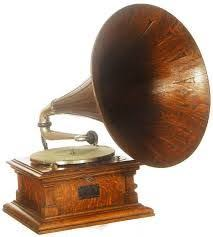
We always had a record player at home and one of my siblings still has our parents’ wonderful collection of 78’s. In our village there was a ‘big house’ where the local gentry had lived for generations. The little boy from the house went to our village school for a few years until he went away to boarding school at 7. While he was in our school I remember going to his birthday parties. His mum used to play music for us for the game of musical chairs on a wind-up gramophone with one of those brass horns as a speaker. A bit like the one below. This was in the mid 50s and none of us had seen one of those before, apart from on the HMV labels.

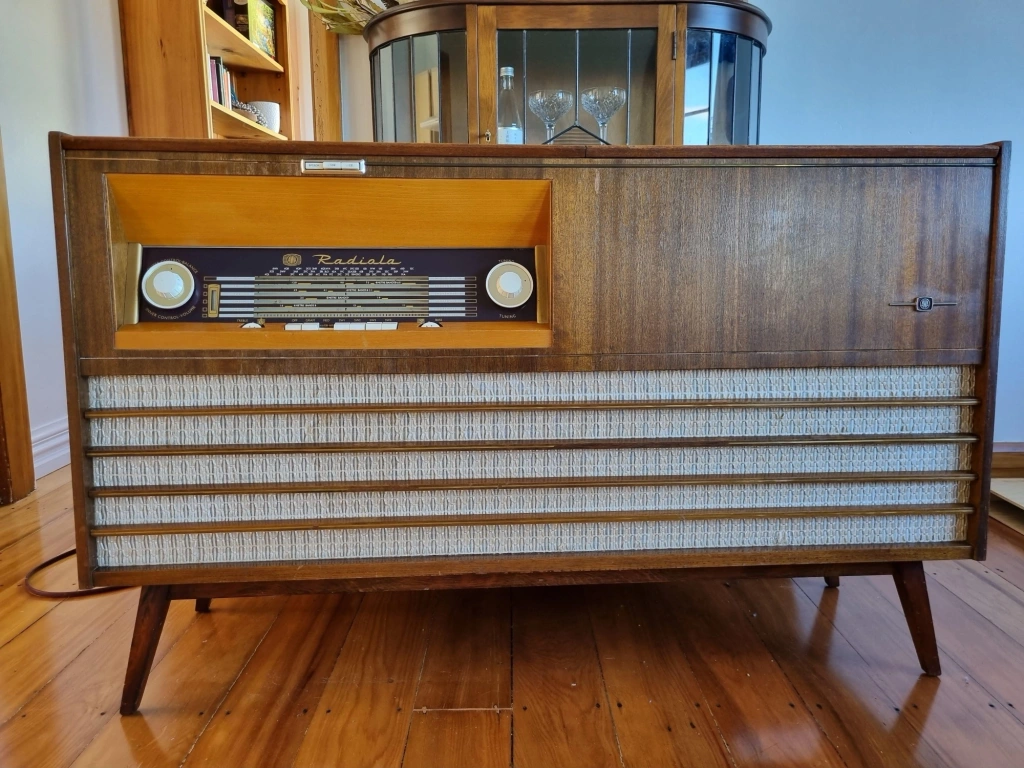
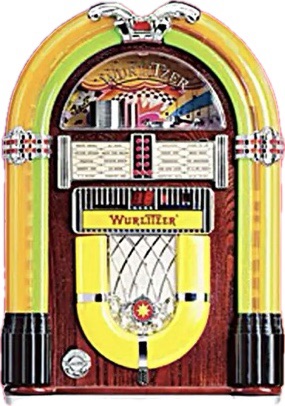
In the early 60s my parents bought a combined radio/ record player known as a radiogram which was housed in a wooden casing like a sideboard. We thought it was very sophisticated!

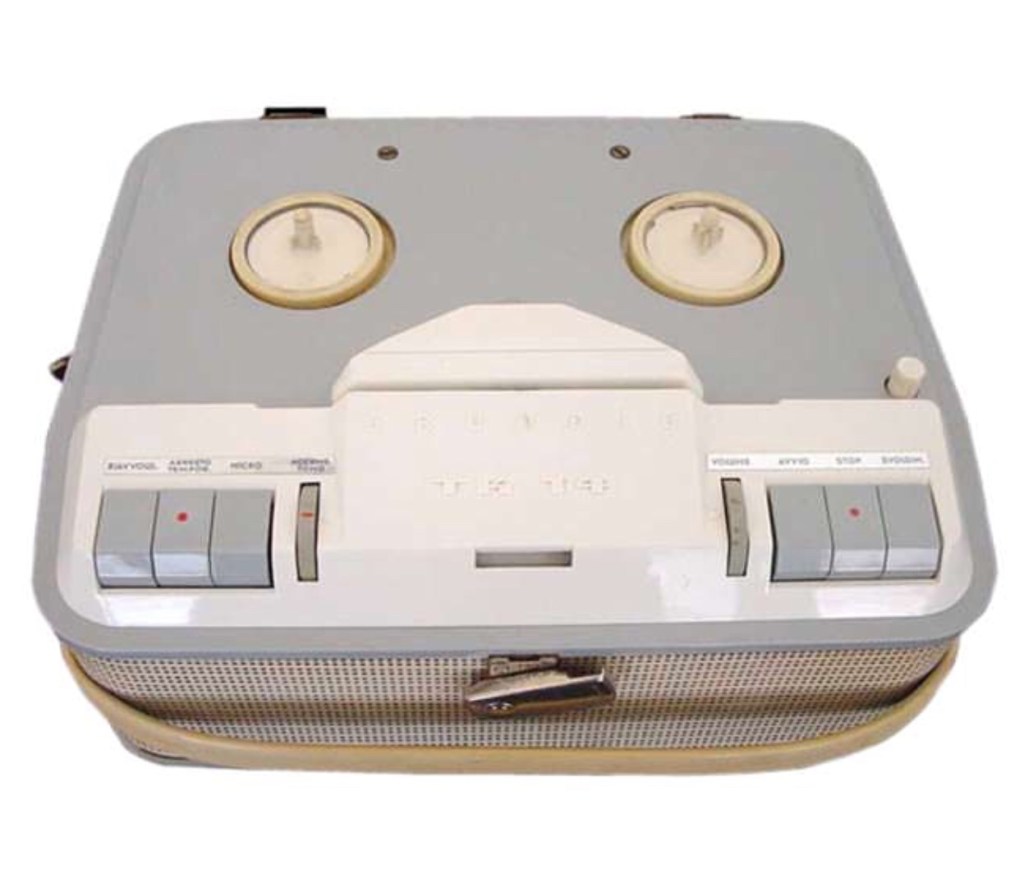
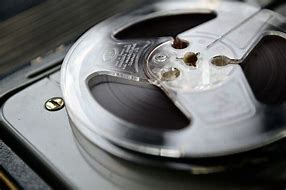
In the mid 60s my mum and dad bought a reel to reel tape recorder. I can still remember that it was a make called the Grundig TK14. My brother, sister and I had so much fun recording music from the radio. We were teenagers by then and into pop music. We couldn’t afford to buy all the records we would have liked to so this was a great way to save our favourite songs to play again and again. We had to hold the microphone next to the radio and be very nifty about pressing STOP just before the presenter started talking again.

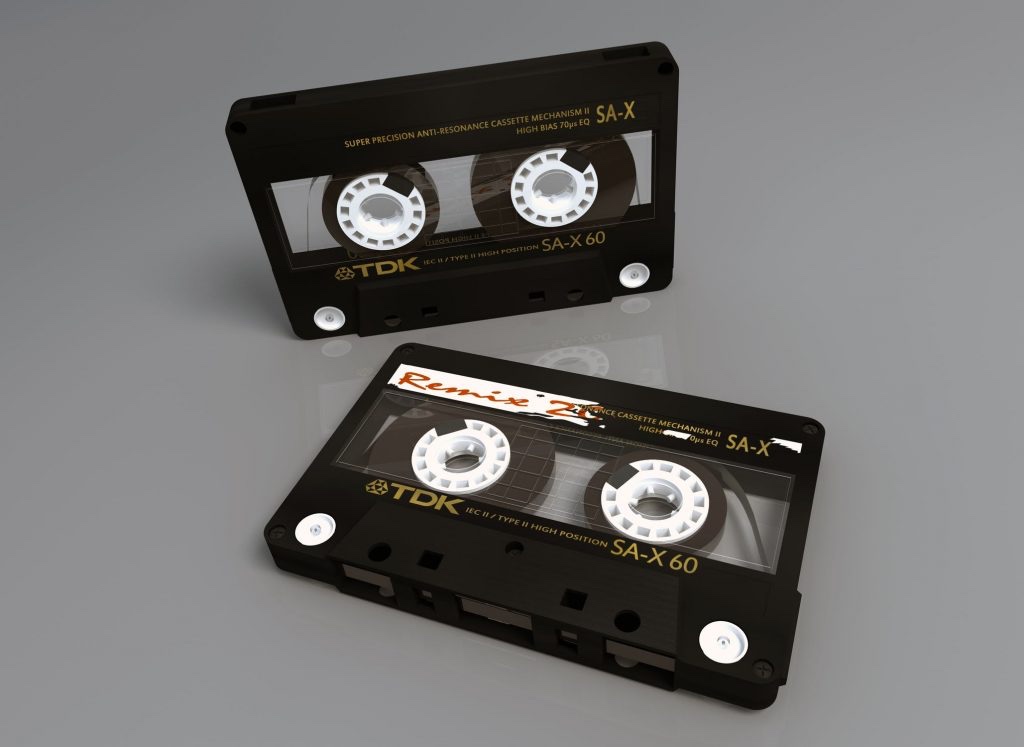
Then along came cassettes. Oh, the joy of swapping albums with friends and recording them onto a C90 or C60. Once I was able to have a cassette player in my car I could listen to my favourite albums as I drove. We’d come a long way from the 78’s and 45’s of my childhood.

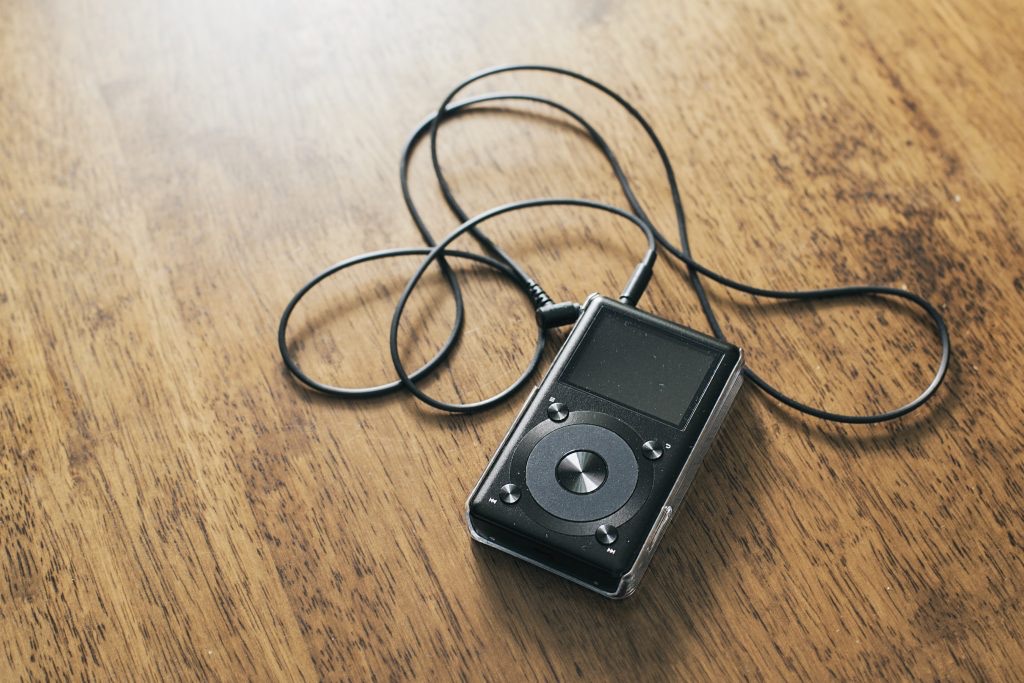
I am now into the eras you will all remember very well. So I will skim through and just mention a few stages which come to mind – The Walkman, the iPod, CD’s and eventually streaming.

Credit to Google Images and Wikipedia. If anyone objects to the inclusion of any images in this post please contact me and it will be removed. Facts are checked but I apologise for any errors you might spot!
Food Shopping

Once again, I’m apologising for such a long absence. I began to fear that I was running out of topics to cover which relate to the 50s and 60s. But I miss blogging and I have acquired a number of followers so I’m going to start again with a topic I know I’ve covered before. Hopefully it’s a bit different this time.

I did a ‘big shop’ this afternoon at a local supermarket. I often find myself musing whilst shopping on how very different food shopping was when I was a child. Not that I ever did the shopping!

As I was browsing along the fruit and vegetable aisles I was choosing between various types of peppers and mushrooms, picking out the best avocados, kiwi fruit and pineapples and wondering which apples to buy. Way back in the 1950s pineapples only came in tins. We had mushrooms when we picked them in the local woods and fields and I’d never heard of peppers or kiwi fruit.

In the aisle displaying tinned goods I bought a tin of coconut milk which I use in curries. Once a year, when the fair came to our local town, my dad would buy or win a fresh coconut. Once home he would drill a hole in it and pour out the coconut milk to share out as an exotic drink. Then he would break the shell up in his garage and share out the pieces so that we could eat the fresh coconut.

In the cereals aisle I walk through two sides of shelves lined with every sort of breakfast cereal from the Corn Flakes, Shredded Wheat and Weetabix of my childhood through a plethora of types too many to list.

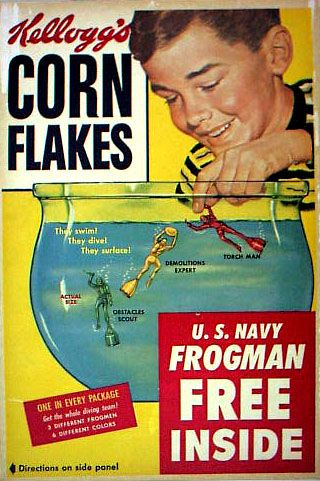
There was often a free toy in cereal packets.

Then on to dairy (and non-dairy). Back in the 50s we had milk and we had cheese. There was normal milk and long life (sterilised) milk. Now there are dozens of different kinds of milk, dairy and non-dairy. Where I lived, deep in rural Wales, our village shop sold one kind of cheese and Kraft cheese spread triangles – which I loved! Yoghurts didn’t come on the scene until the mid 60s.

There were a couple of different tea brands available in the 50s, no frozen goods, no ready meals, no dietary choices such as low fat, vegetarian, vegan, gluten-free, sugar free, organic, decaffeinated. Fruit and veg were largely seasonal apart from oranges and bananas. Very limited and much simpler! But I would rather have the choices of today than the limited range available in the 1950s – even though it’s fun to look back.