Birthday Party Games

When I was a child birthday parties were small affairs and always held in the birthday child’s home with a handful of their schoolmates invited. We always had a birthday tea and a cake with candles on it and the rest of the time was filled with party games.

It’s interesting that some games we are very familiar with from childhood, appear in similar forms all over the world. Are there reasons why we play them which are are common to all people? A lot of these games have a different appearance due to the culture they’re from, but are constructed in the same fashion.

Blind Man’s Buff

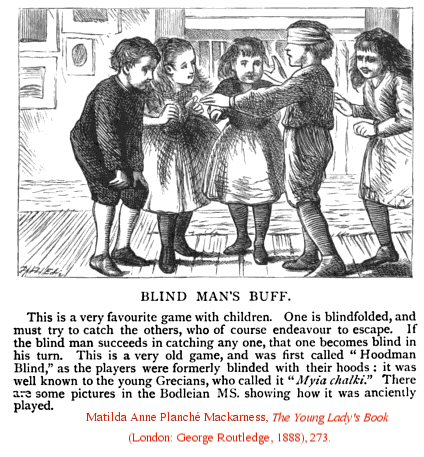
A version of the game was played in Ancient Greece where it was called “copper mosquito.” The game is played by children in Bangladesh where it is known as Kamanchi meaning blind fly. One individual is blind-folded in order to catch or touch one of the others who run around repeating, “The blind flies are hovering fast! Catch whichever you can!” The game was played in the Tudor period, as there are references to its recreation by Henry VIII’s courtiers. It was also a popular parlour game in the Victorian Era. Whilst researching for this post I learned that the name of the game is now considered offensive by some and that the blindfolding of a child can be looked on as dangerous. So maybe it’s disappeared altogether?
Musical Chairs

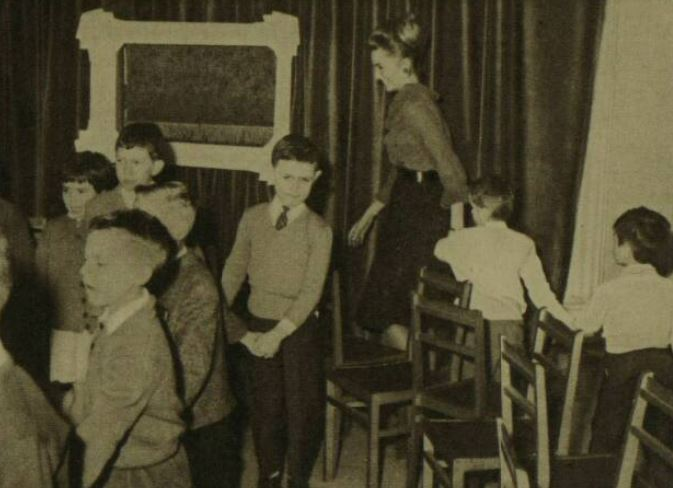
The origins of the game’s name as “Trip to Jerusalem” is disputed. However, it is known to come from its German name Reise Nach Jerusalem (“The Journey to Jerusalem”). One theory suggests that the name was inspired by The Crusades wherein several heavy losses were incurred.
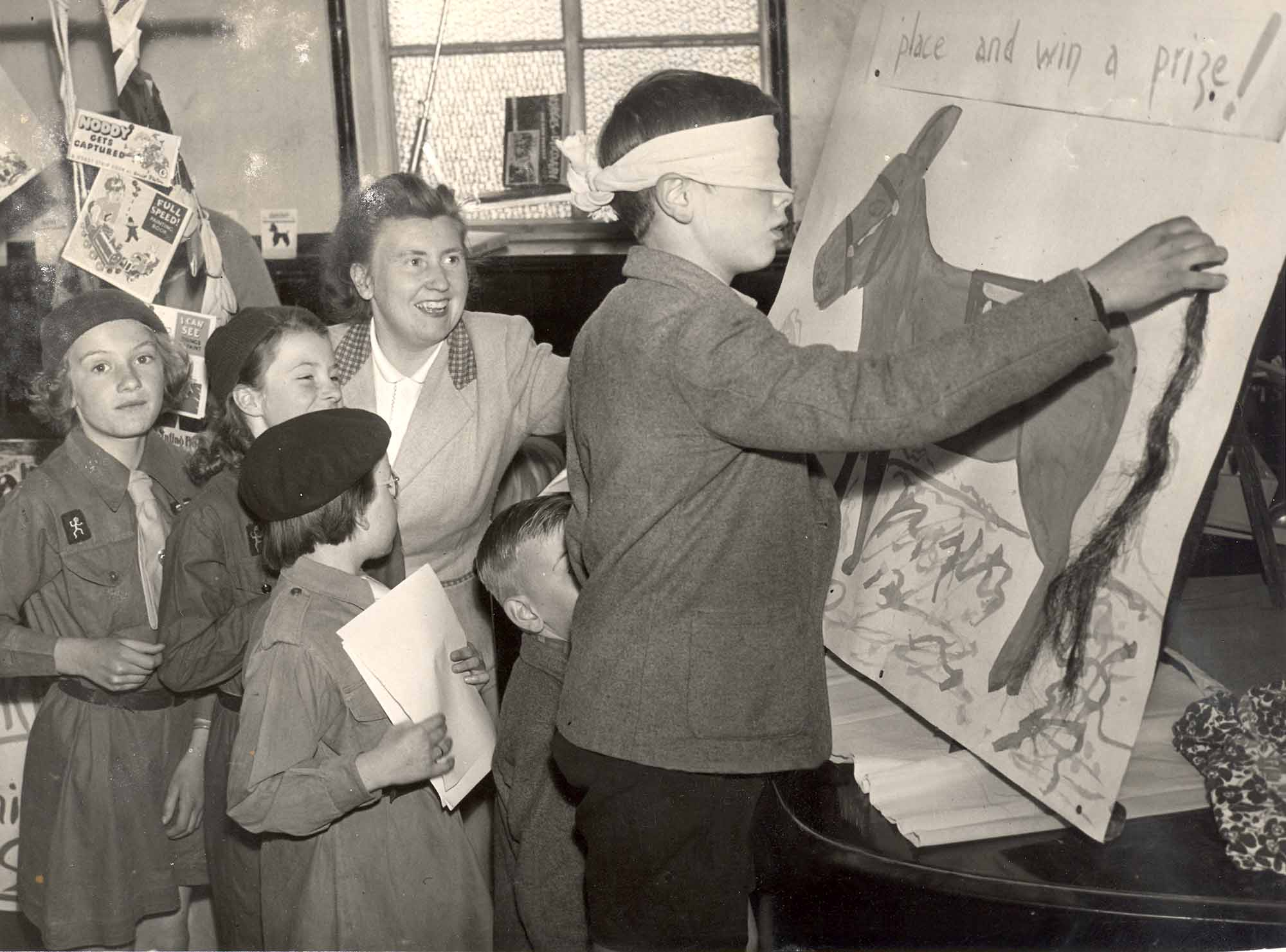
Pin the Tail on the Donkey

Pin the tail on the donkey is a game played by groups of children. The earliest version listed in a catalogue of American games compiled by the American Game Collectors Association in 1998, is dated 1899, and attributed to Charles Zimmerling. My mum used to draw the outline of a donkey on a piece of paper.
Pass the Parcel

Research tells me this is of British origin unlike Blind Man’s Buff which crops up in many cultures. Back in the 1950s the music was either played on a gramophone or on a piano. The parent operating the stop-start music kept a careful eye on the passing of the parcel to make sure everyone had a turn and to ensure that the birthday child was not the one to open the last layer which contained the prize. Back then it was something small like a chocolate bar.

Musical Statues

It seems that this game appears in various countries and has quite a long history. Some countries know it was Freeze Dance or Frozen Statues. Some homes had a parent who played the piano and some had a gramophone with a parent lifting the stylus – just like Pass the Parcel and Musical Chairs.

Dead Lions/ Sleeping Tigers

A great game for calming children down at the end of a party! I can’t find any history on it so it’s perhaps a relatively new invention.

Spin the Bottle/ Plate

On a personal note, I absolutely hated forfeit games! At some of the bigger parties like village parties there was the dreaded (by me!) spin the plate/ bottle game. If the bottle finished its spin pointing to you or if you spun the plate and didn’t get back to your seat in the circle you had to do a forfeit. This usually involved having to sing a song, recite a poem or do something like hop around the room. My worst nightmare!!

Credit to Google Images and Wikipedia. As always, I have endeavoured not to infringe copyright. However, if anyone objects to my use of an image, please contact me and I will remove it.

Greeting Cards

It was my birthday last week and I was lucky enough to get a lot of lovely birthday cards. It got me thinking about how greetings cards have changed in my lifetime. They have changed not only in appearance but also in the range of events we can now send cards for and in the way we send them – there are many ways of sending cards electronically including e-cards and the ones which are ordered and designed electronically but send as paper cards in the post. I will explore all of this in this post.

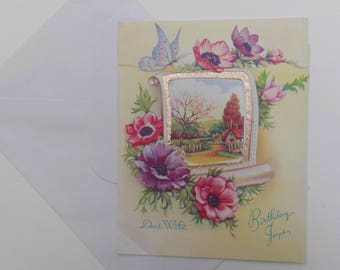
First, here are some examples of the sort of cards which were around when I was a child. I don’t remember ever seeing ‘arty’ cards in the shops or even many funny ones. They were either pretty and floral like most of the ones shown or they were more manly and had cars, footballs or garden spades on them. Children’s cards might have images of children, toys,puppies, kittens or cartoons on them. They all had a certain look which was no doubt dictated by the processes available at the time. Photographic images were used more for picture postcards sent from holidays. Another difference I notice is that there was always a greeting printed on the front whereas now there is often no writing at all on the front, especially on the arty cards. One of the main differences, however, was inside. They always had verses in them.  You can still get cards with verses in them, and some people prefer them, but not every card has a verse. In fact, the ‘Blank for your own message’ style of card has become more common in the last few decades – something which was never, ever seen in the 1950s and 60s! Do any of you remember the dawn of the scented card in the 1950s? What a novelty! One of my grandmothers loved to send cards which had been carefully chosen for the verse and the scent. Fortunately, scented cards are no longer with us.


Image result for 1950's greetings cards uk   Image result for 1950's greetings cards uk


Image result for 1950's greetings cards uk   Image result for 1950's greetings cards uk


Image result for 1950's greetings cards uk

Next, the range of occasions acknowledge with cards today. There were always wedding cards, get well cards, sympathy and congratulations cards and a few more. Also, the 21st birthday was a big milestone. Now we have cards for every decade and sometimes even for half decades like 65 and 75. Below is a selection of current cards – and if you wanted to send one to someone whose cat was going to have an operation, or a friend who’d been made redundant or whose relationship had just broken up, then you buy a ‘Blank for your own message’ card or one saying ‘Just to Say’ or ‘Thinking of You’.

Image result for thank you card for house sitting   Image result for happy 30th birthday card


Image result for happy 75th birthday images    Image result for good luck in your new adventure card

Then, we move on to the different ways we can send cards. The good old postal service is still the main one. But, as well as paper cards we now have e-cards. I subscribe to one and I really rate it. It’s jacquielawson.com and the art work is brilliant. There are many more websites doing them. I find it great if I want to send a fun card to the grandchildren as they are animated. Also, if I am away on holiday and it’s a friend’s birthday or some other occasion, I can log in and choose one and send it on my phone. Amazing, isn’t it? There are also companies like Moon Pig where you choose your card on a laptop or phone, using your own photographs if you like, add your message in a style of your choosing then the card is sent as a paper one through normal post. They are somewhere in between ‘normal’ cards and e-cards, a sort of hybrid.

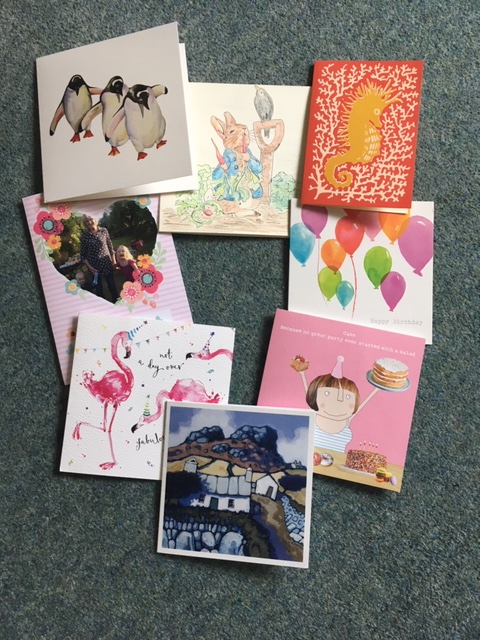
Finally, here are some of the cards I received on my birthday, including a Welsh one. There is a Moon Pig one with a photograph of me on it which one of my daughters had made up for me. Also in there is a hand-made card from a friend who loves making her own cards – a style of card I nearly forgot to mention!

Cards 1    Cards 2

Cards 3