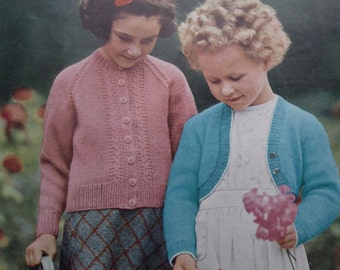
What we wore – the 1950s

The reason this post is not called ‘Fashion’ or ‘Clothes’ is because I am covering the other side of the story. When we think of clothing and fashion in the 1950s and 60s we picture Audrey Hepburn, James Dean, Marlon Brando, Twiggy, Jean Shrimpton, Mary Quant and pop icons such as The Beatles. All this is well documented and easy to research. Being a child in the 50s and a teenager in the 60s, in an area a long way from the large stores, the clothes I wore tell a very different tale.

In my Primary School days I, and all my friends, wore jumpers and cardigans knitted by our mums and dresses, skirts and pinafore dresses sewn on the home sewing machine – hand operated, of course, electric sewing machines were yet to arrive in our homes.

Because most garments were hand made and washing clothes was a once a week event, usually Monday (there were no washing machines), the same jumper and skirt (in winter) or dress and cardigan(summer) would be worn for several days, if not all week, so we didn’t have a huge selection of clothes.

Boys wore grey flannel shorts winter and summer with wool socks up to the knees. A blazer, v-necked jumper or tank top was worn over a shirt and a tie.

     2637e03f3bbe5225e1ff2ed23a92703d--school-life-school-uniforms

Boys’ hair was cut ‘short back and sides’ with a side parting – no exceptions!

We wore knee-high grey or brown socks in winter, short white socks in summer – no tights or trousers, bare knees all year round!

My hair was exactly like that of the girl in blue. I longed for straight hair with a side parting and a bow, like the girl in pink, or long plaits like my friend Valerie. I was stuck with what was known as a ‘bubble cut’

I will be coming back to this topic as there is plenty to say. I will also be moving on into the 1960s and the clothes of my teenage years.


Technology

When we hear the word technology now we think of computers, mobile phones and tablets amongst other things. In the fifties, and then the sixties, new technology was emerging but at a very different level and a slower pace than today. 

In the early 1950’s, in the countryside where I grew up, electricity was established in homes but appliances were limited to lights, a cooker, a radiogram (a large wooden item of furniture housing a record player on one side and a radio on the other) and a vacuum cleaner. Our vacuum cleaner was this model and it was old in the 1950’s!

  
There was big excitement in the family upon the arrival of our first fridge. Milk could be kept fresh for longer in warm weather. Previously, my mum used to hang bottles of milk in the stream in a string bag. Best of all, there was an ice-box. Mum used to pour orange squash into the ice cube tray with a cocktail stick in each cube. Result – our first home-made iced lollies! 

The phone came next. First the lines had to be extended out as far as our house. How exciting it was to watch the workmen putting in the wires and telegraph poles! There is more about telephones in the village in my earlier post Shops and Brands Part 1. 

We didn’t have television until I was 10 in 1961.  I have covered TV in more detail in an earlier post. We had seen televisions previously a few times when staying with relatives who lived in towns but to have one of our own at last was hugely exciting. 


Later, in the 1960’s, we acquired a hair dryer, a hand whisk, our first portable ‘transistor’ radio,  a washing machine (a very early model with a single tub which had a heating element and was filled using a hose connected to the kitchen tap and with a mangle on the top) and a few electric fires to take the edge off cold bedrooms in winter – no central heating! 


Shops and Brands Part 1

When I was very young, from four to thirteen, we lived in a village. There was a village shop and Post Office which was also the village telephone exchange. Ours was not a nucleated village, it was a scattered one. The centre, not a centre as most would know it, was on the main road passing through the village. There was the shop, a chapel next door, a church 50 yards away and a pub 100 yards away. The school was half a mile away in the other direction. Every other house or farm was dotted around a one-mile or so radius.

 
The shop was a 15 minute walk from our house but we loved it! Being a child at the time, my main memory is of the sweets. Sherbet Fountains, Flying Saucers, Spangles, Love Hearts, Refreshers, aniseed balls and pear drops. I could go on! The shop was small and stocked with a limited range of tinned goods, packets and toiletries – as well as sweets. There was a small Post Office counter at right angles to the shop counter. The switchboard was in their sitting room which was next to the shop.

  
For things which couldn’t be grown in the garden or bought in the village shop there was the town, five miles away, and regular vans which drove around the countryside selling their goods. The fish man came on Tuesdays and Fridays, the butcher came mid-week and also on Saturday. Our Sunday joint was always bought from ‘Arthur the butcher’. There was also a bread van, a pop van and a general grocery van. 

The town, although a small market town (two thousand people), it had a few banks, loads of pubs, two chemists’ shops, two newsagents, a shoe shop, two butchers, two bakers, two drapers, two grocers, a greengrocer and an ironmonger. it loads of pubs, two chip shops and a cafe. The drapers and the shoe shop provided most of our regular needs – underwear, school uniform, school shoes. The brands I remember are Clarks, Start-Rite, Ladybird, Cherub, Banner and Trutex.

   
For ‘big’ shopping such as Christmas shopping, new summer clothes, new winter clothes, we went to Swansea (an hour and half drive) or Cardiff (a two hour drive). In between there was catalogue shopping – Marshall Ward, Littlewoods, Kays – essential in that sort of area and in those times.

Public Transport

First of all, I want to point out that I grew up in a remote part of Wales so my memories will not be the same as many other people’s. I hope there is still plenty for you to identify with and I welcome any contributions.  We had no service buses but the village railway station was a walk of about a mile from our house. Trips to the town (five miles away) when my dad was using the car for work, involved my mum walking up to the station with the three of us to catch the train. We hated the walk because we kids inevitably caused us all to be late leaving the house so it wouldn’t be a walk, more of a route march along the lanes to the station. We loved that station! Although a remote, rural station, it had a full-time station master who was wonderful with kids. The waiting room was always cosy and welcoming and in winter had a coal fire burning. I don’t ever remember waiting on the platform with anybody else or seeing any passengers alight at our stop. Even so,  John the station master kept that station immaculate. The trains were amazing! That smell! Each carriage had several compartments. A sliding door led from the corridor into the compartment.    The only time I went on buses or trams was when we went to stay with friends and relatives in Swansea and Cardiff. I loved the trams with the sparking poles connecting with the overhead wires – apologies for the very un-technical jargon! The buses had conductors, an entrance and exit at the rear and – joy of joys! – a stairway to an upper deck. As children, we thought this was the very best way to travel!