I’ve been a long time away from here. Sorry! Things happen.
I was thinking recently about the way we were taught when I was in school. Here are some random musings.
A lot of our teaching was very good. We learned the times tables and even now, anyone who is a liitle older can answer instantly a question like ‘What is 9 X 6?’.
We also had to learn poems off by heart. A love of poetry is a great thing to encourage. To learn what a poem is saying is so much more important than learning a given poem by rote. There even used to be poem recital competitions in school. I’m sure they put most pupils off poetry rather than instilling a love of poems.
When I was approaching the 11+, British readers of a certain age will remember this, we had to learn how to work out simple and compound interest. We were completely unaware what this meant in real life. We just knew how to work out the £%+- etc. I only realised about 20 years later what it was about.
One part of our English (now called literacy) lessons involved learning well known sayings and proverbs. For example, we had to fill in the blanks in
All that – – – – – – – – is not – – – – .
Too many – – – – – spoil the – – – – – .
This now seems quite odd as children today are encouraged to be creative and to write descriptively rather than to use learned phrases.
Any form of games or PE was virtually non-existent. Very occasionally, on a warm sunny day, our two teachers would take us out on the playground with rubber rings, bean bags and quoits. We probably got more exercise playing together at break times! Sometimes, on a fine day, we were all taken for a ‘nature ramble’. It consisted of our two teachers taking all of us, 25/ 30 children from 4 – 11, for a walk along the lanes around our school. Hardly any traffic so it was quite safe! We picked things, were occasionally given the names of plants – and we loved it!
Music was basic and traditional. We sang hymns in both Welsh and English. We also sang patriotic songs like Hearts of Oak and The Skye Boat Song without the faintest idea what they were about. I still have my recorder and my fingers still remember how to play the Skye Boat Song.
History was also traditional and consisted mainly of learning about famous people, mostly heroes and heroines. People like Florence Nightingale, Walter Raleigh and Captain Cook.
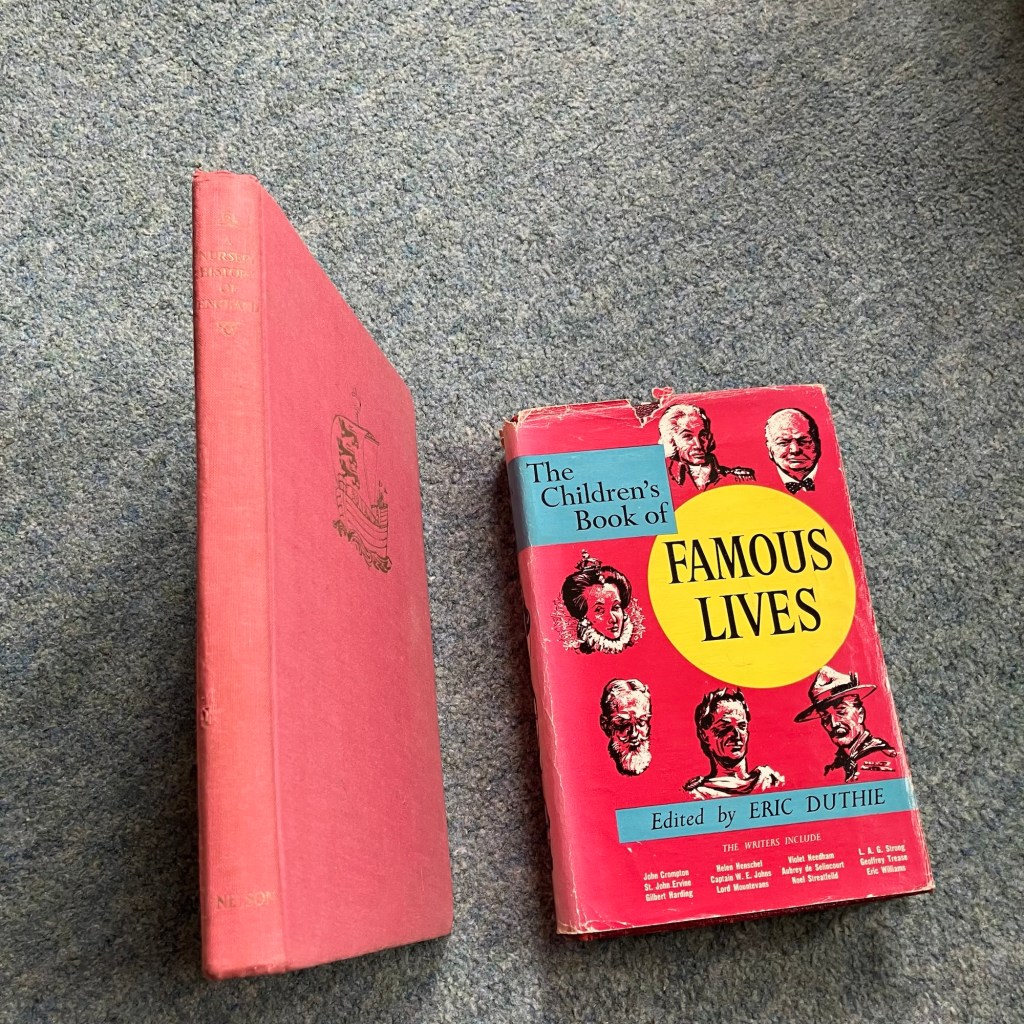
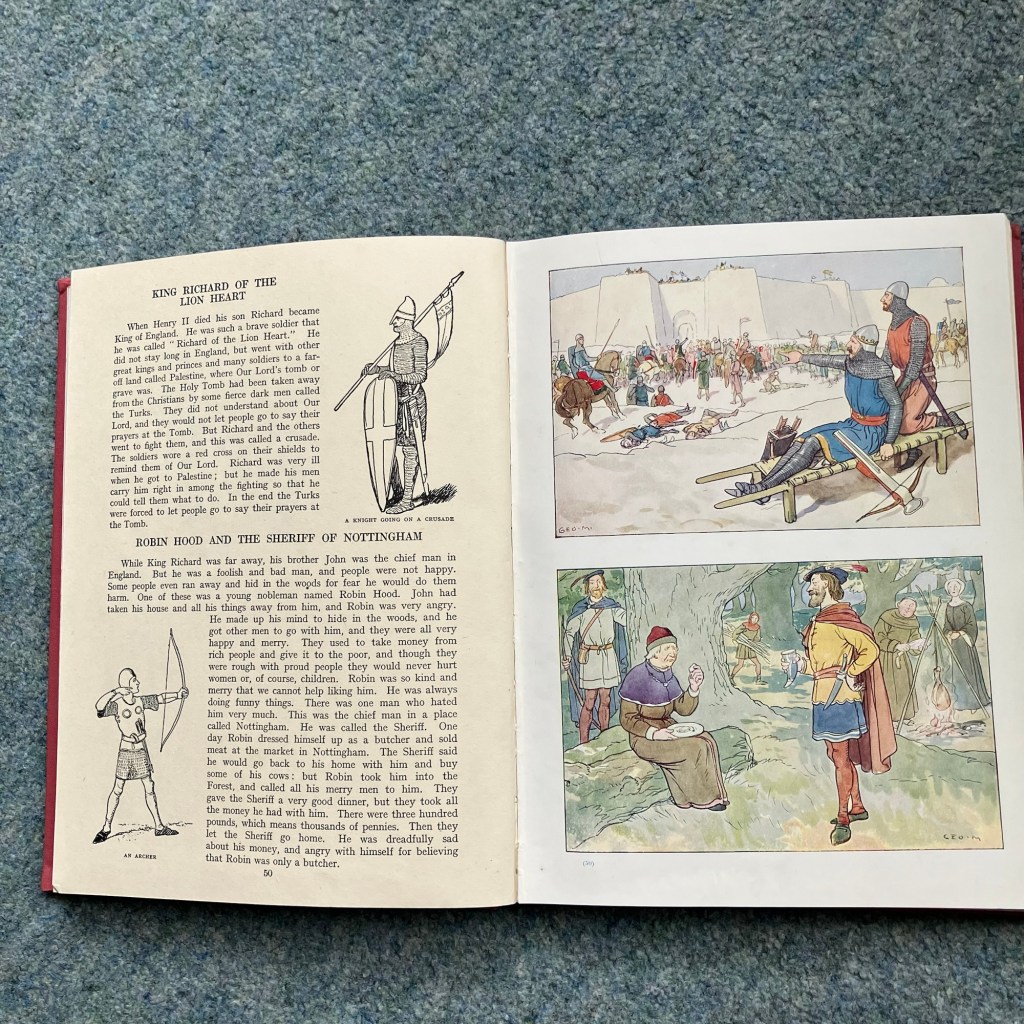
Here are two of my books from when I was a child. The one on the left is called A Nursery History of England (note, not Britain!) and has lovely coloured illustrations of which I’ve shown two.



 ‘Uncle Mac’ the voice of Saturday mornings in the 1950s.
 ‘Sparky’s Magic Piano’ is the second in a series of children’s audio stories featuring Sparky, an original character created for Capitol Records in 1947. Sparky is a little boy with an overactive imagination. His adventures involve inanimate objects which magically come to life and talk to him. This is the one I remember best. Sparky’s voice was Henry Blair and the magic piano’s voice was created using a piece of equipment called Sonovox.
 I was amazed to read that the song ‘The Laughing Policeman’ which I used to hear in the 50s had been recorded in 1926! Charled Penrose sang it and it was written by him and his wife but based on ‘The Laughing Song’ by George Johnson which was first recorded in the 1890s. This was proper music hall stuff!
 Big Rock Candy Mountain next. I loved this song! I loved the way Burl Ives’ wonderful voice and the fantasy world described in the lyrics painted vivid pictures in your mind as you listened. His ‘I Know an Old Lady’ was another regularly played song.
 In 1952, a film was released based on the life of Danish story teller Hans Christian Andersen. Several of the popular songs of the 50s were from this film. Danny Kaye starred as Andersen and sang the ones I remember best – ‘The King’s New Clothes’, ‘Thumbelina’ and ‘The Ugly Duckling’.
 Recorded in 1956, written by Ralph Butler and sung by Mandy Miller the song ‘Nellie the Elephant’ was used for many years to teach the correct rate for compressions in CPR in First Aid classes. Expert opinions differ so don’t take it as gospel!
 The tune to ‘Teddy Bears’ Picnic’ was written by John Walter Bratton in 1907 and the lyrics by Jimmy Kennedy in 1932. Irish born Kennedy lived in Somerset and is buried there. Local folklore claims that a wood in Staplegrove Elm, Somerset was the inspiration for the song. The popular 1950s version was recorded by Val Rosing.
 This novelty song, written by Bob Merrill in 1952, is reputed to be loosely based on the folk tune Carnival of Venice. A recording by Lita Roza was the one most widely heard in the UK, reaching No. 1 on the UK Singles Chart in 1953. It also distinguished Roza as the first British woman to have a number-one hit in the UK chart as well as being the first song to reach number 1 with a question in the title.
 Two children’s Favourites perennials were ‘You’re a Pink Toothbrush’ and ‘Gilly Gilly Ossenfeffer’ by Max Bygraves. He was seen as the amiable family man but was reputed to be a serial philanderer who had many extra-marital affairs, some resulting in children. He did, however, remain devoted to his wife until the end of her life when they were both in their late eighties.
 Yorkshire born Ronnie Hilton was a popular ballad singer who had several hits in the 50s including a Number One hit in 1953. His very popular children’s song was ‘The Windmill in Old Amsterdam’.
 This was such a fun song! So far I have been unable to find out whether ‘The Runaway Train’ is based on a true story. Liverpool born Holliday was hailed as Britain’s answer to crooners like Sinatra. However, he was plagued with mental health issues and died from a suspected overdose in his late thirties.


