Where to start? This has got be one of the most rapidly evolving pieces of everyday equipment in our lifetimes! So I’ll start right at the beginning and do a very quick potted history of the camera – which is now 115 years old. Then I’ll write from personal experience about one of the most amazing gadgets known to Man.

1814 – Joseph Niepce achieved the first photographic image using the camera obscura.
1837 – Louise Daguerre introduced the daguerreotype, a fixed image which didn’t fade.
1851 – Frederick Scott Archer invented the introduced the Collodion process which reduced light exposure time to 2 – 3 minutes.
1888 – George Eastman patented the Kodak roll film camera.
1900 – the first mass-produced camera, the Kodak Brownie, went on sale.
1927 – the General Electric Company invented the modern flash bulb.
1948 – Edwin Land launched the Polaroid camera.
1963 – Polaroid introduced the instant colour film.
1978 – Konica invented the first point and shoot autofocus camera.
1984 – Canon demonstrates the first digital electronic still camera.
2000 – the first mobile phone with a built-in camera appeared.
2004 – 2014 the second generation of smartphones appeared, then from 2015 – 2017 the third generation of smartphones, followed by the fourth generation which have been appearing since 2018.
I was born in 1951. There are no baby photographs of me apart from a studio one taken when I was Christened. My dad had a camera and was a keen photographer. He enjoyed taking pictures of his firstborn. In those days, and for many years after, we were cautious with the number of photographs we took because film and development were both so costly. My mum and dad lived in a very quiet place in South Wales – Brecon, for those who know it. I’m not sure of the details now, and Mum and Dad are gone, so I can’t ask them, but I remember them saying that they went out and when they got home the camera with the roll of film inside it had been stolen from the house. I seem to remember my mum saying they had left it near a window. Nothing else was taken – it was probably the only thing of value in the house – but the worst thing for them was that the roll of film inside was gone and was irreplaceable. As young parents with one salary and bills to pay, it was a while before they could afford a replacement. So, no baby pictures of me.


Some examples of late 1940s cameras. My dad’s might have looked like one of these.
As a keen photographer all his life, in the early 1960’s my dad bought a 35mm camera with which he used to take colour slides. He was also a very organised man so all his slides are labelled and catalogued – and there are hundreds of them! The colour transparency is not as easy to access or copy but even so, it is a fantastic record of our childhood and also of his work in the forests of mid-Wales. The film used to get sent away and we loved the excitement of receiving a new pack of colour slides in the post. Then came the slide show when the projector and screen came out and we all sat, with the curtains drawn, to enjoy the photographs of our holiday, Christmas or a recent birthday.
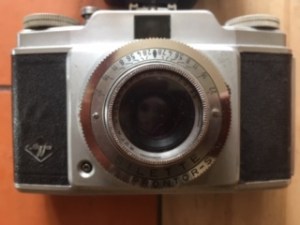
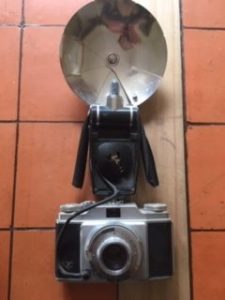


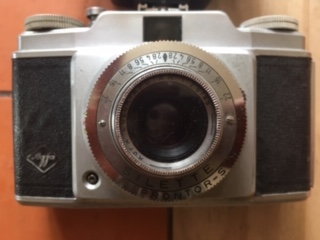
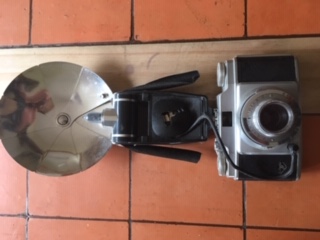
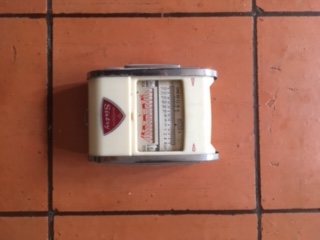
The above photographs are of my father’s much loved and much used camera, flash and light meter which my brother now has in his collection of cameras.
When I was nine I got my first ever camera for my birthday. I was beside myself with excitement! I still have it and I also have several albums full of the photographs I took with it. It was my only camera until I was in my early twenties. It was a Kodak Brownie 127 and this is it!

In 1974 I bought myself a brand new shiny 35mm SLR Zenit E and I was as proud of that as I had been of my Brownie 127 on my ninth birthday. I started off taking slides and then, when I had my first child in 1980, switched to prints. Sharing baby photographs with the family was easier with prints than with slides.
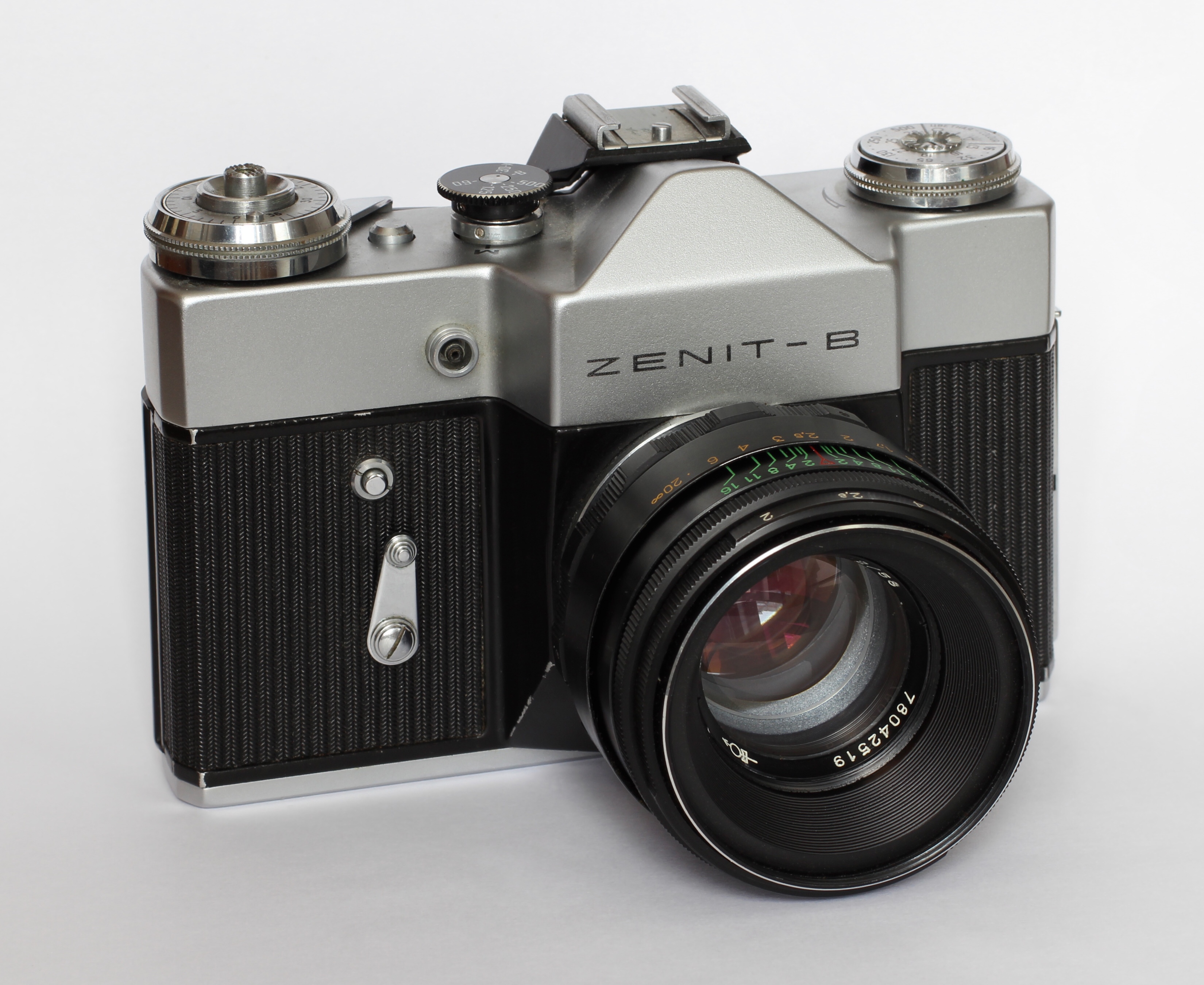
An example of the Zenit E.
Twelve years ago I moved into the digital age when my husband bought me a digital camera for my birthday. It’s a lovely compact size, ideal for carrying in a handbag, and has been a brilliant camera ever since I got it.
However, since the dawn of the smartphone, it gets easier and easier to take photographs with my mobile and, of course, I can send them to people immediately without getting a cable out and downloading the pictures to a computer to save or send. When we go away I take my little digital camera but for day to day stuff I use the handy smartphone in my pocket.
We all take so many photographs now! We do because we can. It’s easy, we don’t have to buy film, send it away for developing, pay for the photographs. We don’t have to adjust any settings if we don’t want to. If we take too many or if any don’t come out right we can just delete them. We can send as many copies to people as we want to. No more digging out the pack of negatives, selecting the right ones, taking them to be developed, waiting a few days – then paying!
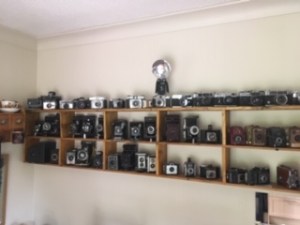
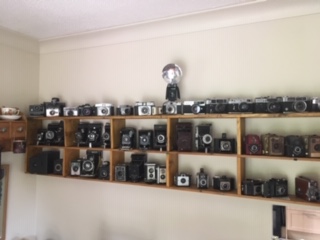
Part of my brother’s collection of old cameras.

 Childhood Memories of growing up in the 1950s and 1960s.